
1940 — Japanese Puppet Government in China
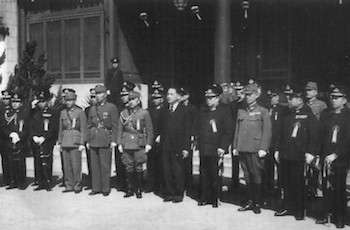 Japan establishes a puppet government in Nanking, China, known as Manchukuo-aligned administration, in an effort to legitimize its occupation of Chinese territory.
This regime is intended to give the appearance of local governance while remaining firmly under Japanese control, reflecting Tokyo’s broader strategy across occupied Asia.
1941 — United States Seizes Axis Ships
President Franklin D. Roosevelt orders the U.S. government to seize more than 60 German and Italian ships docked in American ports.
The move comes after claims that their crews are engaged in sabotage. This action marks another step away from neutrality and toward active involvement in the war.
1942 — War Expands Across Europe and Asia
Deportations to Auschwitz
The first trainloads of Jewish deportees from Paris arrive at the concentration camp at Auschwitz, marking a grim escalation in the Holocaust in Western Europe.
RAF Targets Tirpitz Again
The Royal Air Force makes a second attempt to destroy the German battleship Tirpitz while it lies in port at Trondheim, Norway. The attack once again fails, highlighting the difficulty of neutralizing the heavily defended warship.
Collapse at Toungoo
The 6th Chinese Army abandons Toungoo in Burma and fails to destroy a key bridge over the Sittang River. This critical mistake leaves the route to the Chinese border open for Japanese forces.
The withdrawal also exposes the flank of the 1st Burma Corps, forcing further Allied retreats toward the Yenangyaung oilfields as Japanese advances continue.
Pacific Command Structure Established
The Allies formally divide the Pacific Theater into two major commands.
General Douglas MacArthur is placed in command of the South-West Pacific Area, covering the Philippines, New Guinea, and surrounding regions. Admiral Chester Nimitz commands the Pacific Ocean Areas from Pearl Harbor, overseeing operations across the Central, South, and North Pacific.
This unified command structure significantly improves coordination across the vast Pacific theater.
Pacific War Council Formed
The Pacific War Council is established in Washington, bringing together representatives from Britain, Australia, Canada, China, New Zealand, the Netherlands, the Philippines, and the United States to coordinate strategy and policy.
1943 — Allied Breakthrough in Tunisia
Elements of the British Eighth Army break through Axis defenses at the Gabès Gap in southern Tunisia.
The advance pushes more than 100 miles northward, accelerating the collapse of Axis forces in North Africa.
1944 — Air War Losses and Burma Crisis
German Command Shake-Up
Field Marshals Ewald von Kleist and Erich von Manstein are dismissed by Adolf Hitler and replaced by Ferdinand Schörner and Walter Model, reflecting growing tensions within the German high command.
RAF Losses Over Nuremberg
During a major bombing raid on Nuremberg, the RAF suffers its heaviest losses of the war, losing 96 bombers and approximately 600 aircrew out of 795 aircraft.
The disaster marks a turning point in RAF bombing strategy.
Siege of Imphal Begins
Japanese forces cut the main supply road to Imphal in northeast India, beginning a prolonged siege. Allied troops will rely heavily on air supply to hold their positions against determined Japanese assaults.
1945 — Germany Collapses on All Fronts
Battle for Paderborn
The U.S. First Army begins a three-day battle for the German city of Paderborn, a key objective in the final drive into central Germany.
Soviets Capture Danzig
Soviet forces finally capture the port city of Danzig, taking approximately 10,000 prisoners and seizing 45 German U-boats. The loss of the port deals a major blow to German naval operations in the Baltic.
German Positions Encircled
The cities of Breslau and Glogau are surrounded by Soviet forces, cutting off remaining German troops in these strongholds.
Red Army Enters Austria
Soviet troops cross into Austria north of Kőszeg, bringing the war directly to the German homeland’s southern approaches.
Final Withdrawals in the North
German forces of Army Group Weichsel evacuate their last remaining bridgehead at Wollin, north of Stettin, as the front continues to collapse under Allied pressure.