
In the early spring of 1940, while much of Europe sat frozen in the uneasy silence of the “Phoney War,” Adolf Hitler prepared one of the boldest combined operations of World War II. The target was not France, Belgium, or the Low Countries. Instead, German eyes turned north toward the icy fjords of Norway and the narrow gateways of Denmark.
Operation Weserübung
It would become the first large-scale joint air, sea, and land invasion in modern warfare — and it would drag the war into the mountains, ports, and frozen seas of Scandinavia.
Why Norway Mattered
To many outside observers, Norway appeared neutral and strategically unimportant. But to both Britain and Germany, Norway held enormous value.
During the winter months, Germany relied heavily on iron ore shipments from Sweden. The ore traveled by rail to the Norwegian port of Narvik, then by sea along the Norwegian coast to German factories producing tanks, ships, aircraft, and artillery.
If Britain could cut that route, Germany’s war industry would suffer.
Winston Churchill, then First Lord of the Admiralty, strongly supported mining Norwegian coastal waters to disrupt the shipments. British planners also considered occupying Norwegian ports outright.
Hitler feared exactly that.
If Britain seized Norway first, the Royal Navy could dominate the North Sea, threaten German industry, blockade the Baltic, and establish air bases dangerously close to Germany itself.
So Hitler decided to move first.
The German Plan
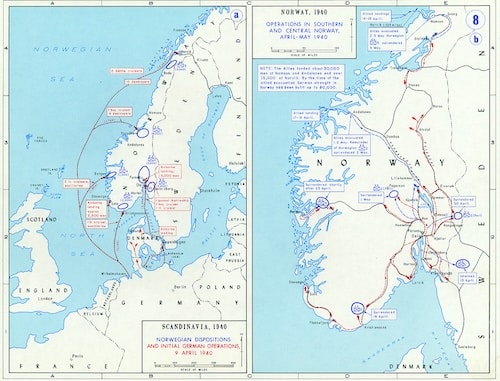 Operation Weserübung called for simultaneous attacks across hundreds of miles of coastline.
German forces would seize:
- Oslo
- Bergen
- Trondheim
- Stavanger
- Kristiansand
- Narvik
At the same time, Denmark would be occupied to secure airfields and protect the southern approaches to Norway.
The invasion depended on speed and surprise.
German destroyers, cruisers, troop ships, and transports would race into Norwegian fjords under cover of darkness while paratroopers and airborne troops seized airfields ahead of advancing infantry.
It was an enormous gamble.
The Kriegsmarine was risking much of its surface fleet in narrow waters dominated by the Royal Navy.
If the invasion failed, Germany could lose the war at sea in a matter of days.
April 8, 1940 — The First Shots
On April 8, British destroyers and submarines encountered German naval forces already steaming north.
The British destroyer HMS Glowworm stumbled into the heavy cruiser Admiral Hipper during a snowstorm.
Outgunned and badly damaged, Glowworm’s commander, Lieutenant Commander Gerard Roope, made a desperate decision.
He rammed the German cruiser head-on.
The impact tore open Hipper’s hull before Glowworm disappeared beneath the waves.
Roope would later receive the Victoria Cross posthumously for his actions.
That same day, the Polish submarine ORP Orzeł sank the German troop transport Rio de Janeiro off the Norwegian coast. Survivors revealed Germany’s invasion plans, but confusion and disbelief prevented the warnings from being fully acted upon.
By the time Norway understood what was happening, German warships were already entering the fjords.
April 9, 1940 — Germany Strikes
Before dawn on April 9, German forces attacked across Scandinavia.
Denmark Falls in Hours
German troops crossed the Danish border while paratroopers seized key airfields and bridges.
Facing overwhelming force and fearing the destruction of Copenhagen, Denmark surrendered within hours.
It was one of the shortest campaigns of the war.
Norway Fights Back
Norway was different.
The rugged terrain, long coastline, and determined resistance created chaos for the invaders.
At Oslofjord, the ancient Norwegian coastal fortress at Oscarsborg stunned the Germans by sinking the heavy cruiser Blücher, killing hundreds of troops and delaying the capture of Oslo long enough for Norway’s king and government to escape.
The delay would prove critical.
King Haakon VII refused German demands to surrender and became a symbol of Norwegian resistance throughout the war.
The Battle for Narvik
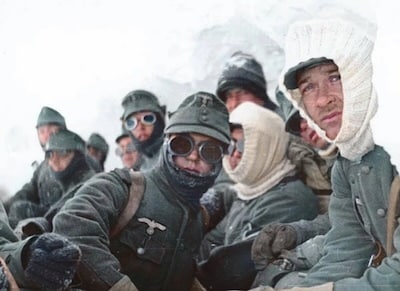
Far to the north, fierce fighting erupted around Narvik.
German destroyers landed mountain troops under General Eduard Dietl, but the Royal Navy soon counterattacked.
In two savage naval battles fought among snow-covered fjords, British destroyers and battleships destroyed much of the German destroyer force trapped inside Narvik harbor.
The fighting was brutal and close-range.
Ships fired at point-blank distance in narrow icy waters surrounded by mountains.
Both sides suffered heavy losses.
For a brief moment, it appeared the Allies might retake Narvik and possibly turn the campaign around.
The Luftwaffe Changes the War
But Norway also demonstrated a terrifying new reality:
Air power now dominated naval warfare.
The Luftwaffe attacked Allied ships relentlessly. German aircraft operating from captured airfields forced the Royal Navy to operate under constant threat from the sky.
British forces found themselves fighting not only German troops, but also weather, mountains, and overwhelming air attacks.
The campaign became a warning of what modern combined warfare would look like.
Allied Failure and Withdrawal
British, French, Norwegian, and Polish troops fought stubbornly across Norway throughout April and May 1940.
Narvik was eventually recaptured by Allied forces in late May.
But events elsewhere in Europe changed everything.
On May 10, Germany invaded France and the Low Countries.
Suddenly Norway became secondary.
Allied troops were withdrawn to fight in Western Europe, leaving Norway to continue alone.
By June 1940, organized Norwegian resistance collapsed.
King Haakon and the Norwegian government escaped to Britain aboard HMS Devonshire and continued the fight from exile.
The Cost of Weserübung
Germany won control of Norway, but at enormous cost.
The Kriegsmarine suffered catastrophic losses:
- 10 destroyers sunk at Narvik
- Heavy cruiser Blücher sunk
- Numerous cruisers and support ships damaged or destroyed
These losses crippled Germany’s surface fleet for the remainder of the war.
Many historians believe the damage suffered during the Norwegian campaign weakened the Kriegsmarine so badly that it affected later operations, including the planned invasion of Britain.
Norway Under Occupation
Norway remained under German occupation for five long years.
Resistance fighters sabotaged German operations, intelligence networks operated along the coast, and Norwegian merchant sailors continued supporting the Allied cause worldwide.
One of the most important resistance efforts involved the sabotage of Norway’s heavy water production facilities, which helped hinder Germany’s atomic research program.
The occupation also tied down hundreds of thousands of German troops that might otherwise have been used elsewhere.
The Legacy of Operation Weserübung
Operation Weserübung changed the war in several important ways.
It demonstrated:
- The effectiveness of combined airborne, naval, and ground assaults
- The growing dominance of air power over naval operations
- The strategic importance of Scandinavia
- The risks of underestimating German speed and coordination
It also marked the beginning of total war spreading into every corner of Europe.
The icy fjords of Norway became one more battlefield in a conflict that was rapidly consuming the world.
And for many sailors, soldiers, and civilians caught in the chaos of April 1940, the war had only just begun.