1940 — U.S. Support for the Allies Grows
The United States authorizes the sale of military aircraft to Allied nations, marking another step away from strict neutrality. Although not yet at war, the U.S. increasingly supports Britain and other nations resisting Axis aggression.
In Britain, the government doubles the butter ration to half a pound per week, reflecting continued adjustments to rationing as the nation balances civilian needs with wartime supply demands.
1941 — Yugoslavia Joins the Axis Under Pressure
Facing intense diplomatic and military pressure from Germany, Yugoslavia signs the Tripartite Pact, formally joining the Axis powers alongside Germany, Italy, and Japan.
However, the agreement sparks immediate backlash. Anti-Axis protests erupt in Belgrade, with large crowds demonstrating against the government’s decision. The unrest foreshadows the political upheaval and German invasion that will soon follow.
1942 — War Production and Global Deployments
U.S. Troops Occupy the Society Islands
American forces move into the Society Islands in the South Pacific, strengthening Allied defensive positions and helping secure key supply routes across the region.
Standard Oil Case
William Stamps Farish II, president of Standard Oil, pleads no contest to charges of conspiring with Nazi Germany and withholding critical patents related to synthetic rubber from the U.S. government. The case underscores the importance of industrial resources in modern warfare.
U.S. Navy Expands Atlantic Role
Task Force 39 departs from Maine bound for Britain, where it will help escort convoys carrying supplies to the Soviet Union. This allows the Royal Navy to shift resources toward the Mediterranean and planned operations such as the invasion of Madagascar.
Arrival of the B-26 Marauder
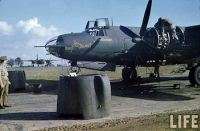
The first Martin B-26 Marauder medium bombers arrive in a combat theater at Brisbane (Archerfield Airfield), Australia. The fast and heavily armed aircraft will go on to become one of the most effective Allied bombers of the war.
1943 — Turning the Tide in the Atlantic
Greek Partisan Success
Greek resistance fighters temporarily seize control of Samos Island from Italian forces, demonstrating the growing effectiveness of partisan movements in occupied Europe.
Spain Closes Its Border
Neutral Spain closes its border with Nazi-occupied France, signaling a cautious shift away from cooperation with Germany as the war begins to turn in favor of the Allies.
Convoy HX-231 Holds Firm
The battle for convoy HX-231 begins in the North Atlantic. For the first time, an Allied convoy successfully fends off U-boat attacks without suffering any losses, marking a turning point in the Battle of the Atlantic.
1944 — Eastern Front and Pacific Air War
German Breakout Near Lvov
Field Marshal Erich von Manstein persuades Adolf Hitler to allow the First Panzer Army to break out westward from encirclement near Lvov, avoiding destruction and preserving a significant German force on the Eastern Front.
Heavy Bombing in New Guinea
In the Pacific, intense bombing by the U.S. Fifth Air Force targets Japanese positions at Wewak. The sustained attacks force the Japanese to relocate their air headquarters to Hollandia, weakening their operational capabilities.
1945 — Final Allied Push Across Europe and the Pacific
Breakout from Remagen
The U.S. First Army breaks out from its Remagen bridgehead, accelerating the Allied advance into western Germany.
British Capture Wesel
The British Second Army captures the city of Wesel, which has been almost completely destroyed by Allied bombing during the Rhine crossing operations.
Bombardment of Okinawa Begins
The U.S. Navy begins an intense pre-invasion bombardment of Okinawa, firing more than 500,000 shells and rockets over the course of a week in preparation for one of the largest amphibious assaults of the war.
Final Strategic Mission of the 15th Air Force
The U.S. Fifteenth Air Force, operating from bases in Italy, flies its final strategic bombing mission of the war. Approximately 650 bombers strike targets in Prague and Cheb in Czechoslovakia.
SS Assassination Behind Allied Lines
German SS forces operating behind Allied lines assassinate the Allied-appointed mayor of Aachen, highlighting continued resistance and instability even as Germany collapses.