
1940 — Germany Moves Against Norway
RAF reconnaissance aircraft spot major units of the Kriegsmarine steaming north toward Narvik and Trondheim.
The German warships are heavily loaded with troops, equipment, and supplies intended for the upcoming invasions of Norway and Denmark.
The sightings confirm Allied fears that Germany is preparing a major operation in Scandinavia, although the full scale of the invasion is not yet understood.
1941 — Axis Advances in the Balkans and North Africa
Britain Raises Taxes for the War
The British government unveils a new wartime budget that includes increased income taxes to help finance the enormous cost of the conflict.
Britain’s economy is now fully committed to total war.
German Forces Drive Toward Salonika
German troops advancing through Yugoslavia and Greece push toward the strategically important Greek city of Salonika (Thessaloniki).
The rapid German advance threatens to split Allied defenses in the Balkans.
Britain Cuts Relations with Hungary
Great Britain formally severs diplomatic relations with Hungary following its participation in Axis operations against Yugoslavia.
Skopje Falls
German forces capture Skopje in Macedonia, forcing Yugoslav units in southern regions to withdraw.
The collapse of Yugoslav resistance exposes the flank of the Greek Army and accelerates the broader Axis offensive across the Balkans.
Britain publicly reaffirms its support and allegiance to Yugoslavia despite the deteriorating military situation.
Rommel Captures Derna
The German 5th Light Afrika Division captures the Libyan port city of Derna.
During the fighting, British Generals Richard O’Connor and Philip Neame are captured after becoming lost behind advancing German lines.
The loss of the two senior commanders is a serious blow to British operations in North Africa.
1942 — Bataan Nears Collapse
Silver Replaces Copper in U.S. Industry
The U.S. Treasury loans approximately 40,000 tons of silver to electrical manufacturers to replace scarce copper used in industrial conductors.
The copper saved by the substitution is redirected toward military production.
Japanese Break Through on Bataan
After four days of intense combat, Japanese forces penetrate approximately four miles into American and Filipino defensive positions on Bataan.
General Jonathan Wainwright’s exhausted and starving troops are pushed to the brink of collapse as Japanese artillery, tanks, and infantry continue their relentless assault.
The fall of Bataan is now imminent.
1943 — Hitler Attempts to Hold the Axis Together
Hitler Meets Mussolini
Adolf Hitler spends several days at Klessheim Castle near Salzburg attempting to persuade and pressure Benito Mussolini into continuing Italy’s commitment to the Axis war effort.
Concerned by Mussolini’s declining confidence and growing Axis setbacks, Hitler summons leaders from several Axis-aligned governments throughout April for a series of meetings intended to strengthen morale and unity.
By this stage of the war, however, Axis confidence is rapidly fading.
Allied Armies Link Up in Tunisia
The British Eighth Army links up with the American II Corps in central Tunisia.
Meanwhile, the British First Army continues advancing in northern Tunisia, tightening Allied control and placing increasing pressure on Axis forces trapped in North Africa.
Japanese Bombing Offensive in the Solomons
The Japanese launch a ten-day, around-the-clock air offensive against Allied shipping in the Solomon Islands.
The attacks are intended to disrupt American supply lines and slow Allied operations in the South Pacific.
1944 — Goebbels Tightens Control and Auschwitz Escapees Warn the World
Goebbels Takes Control of Berlin
Nazi propaganda minister Joseph Goebbels is given overall control of Berlin’s administration as Germany prepares for increasing Allied bombing and the possibility of invasion.
Escape from Auschwitz-Birkenau
Two Jewish prisoners escape from Auschwitz-Birkenau and successfully reach Czechoslovakia.
One of the escapees, Rudolf Vrba, compiles a detailed report describing the mass extermination taking place inside Auschwitz.
The report is forwarded through diplomatic channels to the Vatican and becomes one of the earliest comprehensive accounts warning the outside world about the scale of the Holocaust.
1945 — The Sinking of Yamato and the Collapse of Germany
American Advances Continue in Germany
The U.S. First Army captures Göttingen, northeast of Kassel, while the U.S. Ninth Army captures Hameln and Eisenach.
German resistance continues to weaken as Allied armies advance deeper into the Reich.
Army Group Centre Counterattacks
German Army Group Centre, commanded by General Ferdinand Schörner, launches continued counterattacks against Soviet forces of the 2nd and 4th Ukrainian Fronts.
Despite localized resistance, German forces are steadily losing ground across Central Europe.
German Withdrawal from Sarajevo
German Army Group E, under General Alexander Löhr, evacuates its remaining forces from Sarajevo as Yugoslav Partisans continue liberating the Balkans.
The Battleship Yamato is Sunk
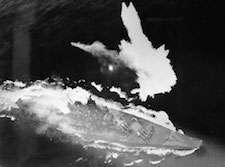
The Battle of the East China Sea begins when aircraft from U.S. Task Force 58 attack the Japanese super-battleship Yamato.
During a furious three-hour battle southeast of Japan, waves of American carrier aircraft overwhelm the massive warship.
Yamato, one of the largest battleships ever built, is sunk along with four destroyers. Japanese losses total approximately 2,488 sailors killed and dozens of aircraft destroyed.
The sinking symbolizes the end of the battleship era and the overwhelming dominance of carrier-based naval aviation.
Nazi Gold and Art Found at Merkers
Troops of the U.S. Third Army discover a massive cache of Nazi gold, currency, and stolen artwork hidden inside a salt mine at Merkers, Germany.
The treasure, estimated at approximately $500 million, includes gold reserves, priceless artwork, and valuables looted from across occupied Europe.
 First Fighter-Escorted B-29 Mission Over Japan
 First Fighter-Escorted B-29 Mission Over Japan
B-29 Superfortresses conduct their first fighter-escorted mission against Japan using P-51 Mustangs based on Iwo Jima.
The new escort capability significantly improves bomber protection during raids against the Japanese home islands.