
1936 — War in Ethiopia Intensifies
Italian forces escalate their campaign in East Africa by firebombing the Ethiopian city of Harar. The attack is part of Italy’s broader effort to crush Ethiopian resistance and consolidate control following its invasion of the country.
The use of aerial bombardment against civilian areas reflects the increasingly brutal nature of modern warfare leading into World War II.
1940 — Anti-Jewish Restrictions Tighten
In German-occupied territories, new regulations decree that only Jewish doctors may treat Jewish patients. The policy further isolates Jewish communities and strips them of access to broader medical care.
These measures are part of the expanding system of discrimination that will soon evolve into widespread deportations and mass murder.
1941 — Naval Victory and Strategic Planning
Vichy France Establishes Jewish Affairs Office
The Vichy French government creates a Commissariat for Jewish Affairs, formalizing state-sponsored discrimination and aligning French policy more closely with Nazi anti-Semitic laws.
Battle of Cape Matapan
In the Mediterranean, Italian naval forces attempt to intercept a British convoy escorted by cruisers and destroyers. The British fleet, under Admiral Andrew Cunningham, skillfully lures the Italians toward the main body of the Mediterranean Fleet, which includes battleships and the aircraft carrier HMS Formidable.
Aircraft launched from Formidable strike the Italian battleship Vittorio Veneto with a torpedo, forcing it to withdraw. Later, the cruiser Pola is also hit and disabled.
As Italian ships attempt to assist Pola, British forces intercept and launch a devastating night attack. The cruisers Zara, Fiume, and the already crippled Pola are sunk, along with two destroyers. British losses are minimal, totaling just two aircraft.
The engagement becomes one of the most decisive Allied naval victories of the Mediterranean war.
Anglo-American War Planning
After two months of discussions, U.S. and British military leaders conclude a staff conference outlining plans for cooperation if the United States enters the war.
The most important outcome is the agreement on a “Germany First” strategy, prioritizing the defeat of Nazi Germany before focusing fully on Japan.
1942 — Convoys, Malta, and Home Front Preparations
Arctic Convoy PQ-13 Defended
Escort ships protecting Convoy PQ-13 successfully repel a German destroyer attack in Arctic waters, sinking the destroyer Z26. The convoy continues its dangerous journey to the Soviet Union.
Spitfires Reinforce Malta
Another group of 16 Supermarine Spitfires is delivered to Malta by Force H, strengthening the island’s air defenses as it remains under constant Axis attack.
Australia Prepares for Invasion
The Australian War Cabinet implements a “Total Denial” policy in northern Australia in the event of a Japanese invasion.
The plan calls for a fighting withdrawal, with the destruction or evacuation of resources to deny their use to the enemy. Large-scale livestock movements southward begin, earning participants the nickname “Overlanders.”
1943 — Retreat in Burma and U.S. Rationing
Allied Withdrawal in Arakan
British and Indian forces begin withdrawing from the Arakan region of Burma under heavy pressure from Japanese troops, highlighting the challenges of jungle warfare.
Meat Rationing in the United States
Meat rationing begins in the United States, set at approximately 28 ounces per week per person, as the government balances civilian consumption with military supply needs.
1944 — U.S. Navy Strikes the Palau Islands
The U.S. Navy launches a powerful bombardment of the Palau Islands, east of the Philippines.
The attack destroys approximately 150 Japanese aircraft, six naval vessels, and an estimated 100,000 tons of shipping, significantly weakening Japanese defenses in the region.
1945 — Allied Advance into Germany
Seventh Army Captures Mannheim and Heidelberg
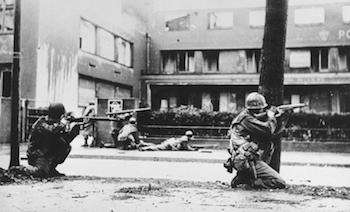 The U.S. Seventh Army captures the German cities of Mannheim and Heidelberg. As German forces retreat, they destroy the historic Alte Brücke over the Neckar River in an attempt to slow the Allied advance.
Soviets Capture Küstrin
After fierce fighting, troops of the 1st Belorussian Front capture the fortress town of Küstrin, a key defensive position on the Oder River.
Oilfields in Hungary Fall
Soviet forces seize vital oilfields south of Komárom in Hungary, depriving Germany of one of its last remaining sources of petroleum and further crippling its war effort.