
1936 — Hitler Declares Germany’s Independence from International Judgment
Adolf Hitler addresses a massive crowd of approximately 300,000 supporters, declaring that Germany recognizes no authority above itself except God. The speech reinforces Nazi propaganda that Germany’s destiny should be determined by the German people alone, rejecting the restrictions imposed by the Treaty of Versailles and international institutions.
This rhetoric reflects the growing confidence of the Nazi regime as it continues rebuilding German military power and expanding its influence across Europe.
1939 — The End of Czechoslovakia
Nazi Germany formally dissolves what remains of the Republic of Czechoslovakia. Following months of pressure and internal political manipulation, the country is dismantled as German forces move to occupy strategic areas.
The destruction of Czechoslovakia demonstrates that Hitler’s territorial ambitions extend far beyond the claims of protecting ethnic Germans that had been used to justify earlier expansions.
1941 — War Expands Across Asia and the Pacific
Japanese Long-Range Fighter Raid
Japanese fighter aircraft conduct a long-range attack against Chengtu (Chengdu), China. The mission represents the longest-range fighter operation carried out to date in the war, demonstrating the expanding capabilities of Japanese air power in the China theater.
1942 — American Forces Arrive in Australia
Large numbers of United States troops arrive in Australia, marking a major step in establishing the country as the primary Allied base for operations in the South-West Pacific.
At the same time, General Douglas MacArthur arrives in Mindanao after escaping from the besieged fortress of Corregidor under orders from President Roosevelt. MacArthur had vowed that he would return to liberate the Philippines.
1943 — Political Changes and Fighting Across Europe
 French North Africa Reorganized
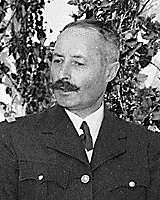 French North Africa Reorganized
General Henri Giraud restores representative government in French North Africa and begins dismantling organizations loyal to the Vichy regime. The move strengthens Allied political control in the region following the success of Operation Torch.
German Forces Retake Kharkov
German armored forces recapture the strategically important Ukrainian city of Kharkov. The victory temporarily stabilizes the Eastern Front after Soviet advances earlier in the year.
The Krakow Ghetto Destroyed
Nazi authorities liquidate the Krakow Ghetto, deporting thousands of Jewish residents to concentration camps and executing many others. The destruction of the ghetto forms part of the systematic implementation of the Holocaust across occupied Poland.
Submarine Thunderbolt Lost
The British submarine HMS Thunderbolt, previously known as HMS Thetis, is sunk off the coast of Sicily by the Italian corvette Cicogna. The submarine had earlier been renamed after being salvaged following a tragic pre-war training accident.
1944 — Fighting in Burma
British and Indian forces conducting operations in Burma are forced to withdraw toward Imphal in Assam while fighting a determined rearguard action against advancing Japanese forces.
Japanese troops cut the critical road running north from Tiddim to Imphal, preventing Indian forces from retreating easily and creating a dangerous situation for Allied units in the region.
1945 — Allied Forces Press Forward
Third Army Crosses the Moselle
The U.S. Third Army crosses the Moselle River southwest of Koblenz, continuing its rapid advance toward the heart of Germany as Allied forces close in from both the western and eastern fronts.
German Offensive at Lake Balaton Ends
German attempts to recapture the vital oilfields near Lake Balaton come to an end as Soviet forces halt the offensive. The Red Army also cuts communications between Königsberg and German troops trapped in the Braunsberg Pocket in East Prussia.
First Use of the Grand Slam Bomb
RAF Bomber Command deploys the massive 22,000-pound “Grand Slam” earthquake bomb for the first time. The bomb destroys the Bielefeld viaduct, demonstrating the devastating power of the new weapon designed to penetrate hardened targets.
Heavy Allied Bombing Raids
The U.S. Fifteenth Air Force, flying from bases in Italy, launches a major raid involving roughly 500 bombers against the German city of Regensburg. At the same time, the RAF attacks Wuppertal with approximately 400 aircraft.
Filipino Guerrillas Capture San Fernando
On the island of Luzon, Filipino guerrilla forces led by U.S. Colonel Russell Volckmann capture the town of San Fernando. Volckmann had refused to surrender to Japanese forces in 1942 and continued leading resistance operations throughout the occupation.
American Infantry Arrive in China
The first U.S. infantry units arrive in China as part of the MARS Task Force. The troops are transported by the Air Transport Command to support Chinese forces fighting the Japanese.
Fighting Continues on Iwo Jima
U.S. forces continue clearing operations on Iwo Jima while launching heavy attacks against remaining Japanese positions in the northern part of the island. The brutal battle is nearing its final stages.