
The Question Every GI Asked: When Can I Go Home?
When Germany surrendered on May 8, 1945, celebrations erupted across Europe. Church bells rang, crowds filled city streets, and Allied soldiers who had survived years of war finally allowed themselves to think about home.
But for millions of American service members, victory in Europe created a new uncertainty.
Who would go home first?
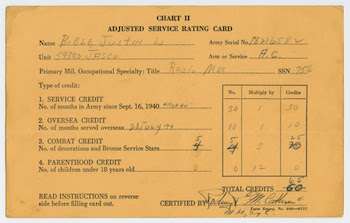 The United States military had grown into a force of nearly 12 million men and women during World War II. Approximately three million Americans were stationed in Europe alone by the spring of 1945. Returning such a massive force home while simultaneously preparing for the invasion of Japan represented one of the largest logistical challenges in military history.
To solve the problem, the War Department introduced a numerical system that would determine demobilization priority: the Adjusted Service Rating Score, or ASRS.
What Was the Adjusted Service Rating Score?
On May 10, 1945, just two days after Germany’s surrender, the War Department officially announced the point system that would determine which soldiers would be sent home first.
The idea was simple: service members earned points based on their military service, combat participation, decorations, and family responsibilities.
The higher the score, the sooner a soldier could expect to leave Europe and return to the United States.
How Points Were Calculated
Each service member received:
- 1 point for every month in military service
- 1 additional point for every month served overseas
- 5 points for each campaign participated in
- 5 points for qualifying decorations and awards
- 12 points for each dependent child under age 18
Several awards counted toward the score, including:
- Medal of Honor
- Distinguished Service Cross
- Distinguished Service Medal
- Legion of Merit
- Silver Star
- Distinguished Flying Cross
- Soldier’s Medal
- Bronze Star Medal
- Air Medal
- Purple Heart
 One notable omission immediately drew complaints from combat veterans: the Combat Infantryman Badge (CIB) was worth zero points despite representing frontline combat service.
Many infantrymen who had spent months under fire felt this was a significant injustice.
The Campaign Credit System
Campaign participation also contributed heavily to a soldier’s score.
The U.S. Army recognized sixteen major campaigns during the European war. Each campaign credit added five points.
Even the most battle-hardened divisions, however, rarely accumulated more than eight or nine campaign stars.
A soldier who had landed in Normandy, fought through France, Belgium, the Ardennes, and crossed into Germany could accumulate a substantial score from campaign participation alone.
Family Matters
The Army recognized that soldiers with young families faced unique hardships.
Each dependent child under eighteen years old was worth twelve additional points.
Men with three or more dependent children could often qualify for early return regardless of their overall score.
Interestingly, age, marital status by itself, and dependents over eighteen years old did not affect a soldier’s score.
The Magic Number: 85 Points
Initially, a service member needed 85 points to qualify for immediate return to the United States.
Once that threshold was reached, additional points offered no advantage.
A soldier with 110 points did not necessarily go home before a soldier with 85.
This rule frustrated many troops who believed longer service or heavier combat experience should place them at the front of the line.
One of the Biggest Complaints
The ASRS measured time and qualifications—but not danger.
A month spent driving a truck in a rear-area depot counted the same as a month spent fighting in the hedgerows of Normandy or the forests of the Ardennes.
Many frontline infantrymen believed the system failed to properly recognize the realities of combat service.
The omission of Combat Infantryman Badge points only intensified those complaints.
Organizing the Army for Demobilization
The Army also faced another challenge.
Points applied to individuals, but transportation and administration were organized by units.
As a result, soldiers had to be reassigned in large numbers.
High-point soldiers were transferred into units scheduled for return while low-point soldiers were reassigned to occupation forces or future deployments.
Operation Magic Carpet
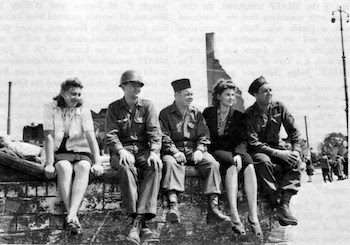 Units in Europe were divided into four categories:
- Category I: Occupation troops remaining overseas
- Category II: Units earmarked for redeployment or Pacific service
- Category III: Reorganization units
- Category IV: Personnel eligible for immediate return home
The success of the ASRS depended on one enormous transportation effort.
Known as Operation Magic Carpet, the mission involved moving millions of American troops home from Europe, the Pacific, and every corner of the globe.
Liberty ships, troop transports, aircraft carriers, and even battleships were converted to carry returning veterans.
The operation ultimately transported more than eight million personnel, making it one of the largest troop movements in history.
Because demobilization progressed faster than expected, point requirements were repeatedly lowered throughout late 1945.
Protests Erupt Around the World
 By early 1946, a new problem emerged.
The Army suddenly realized it was losing manpower faster than occupation forces could be maintained.
The War Department slowed demobilization.
The reaction was immediate.
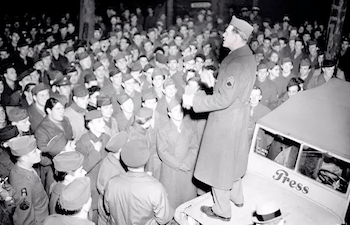
Thousands of American troops staged protests in Germany, Austria, France, India, the Philippines, and the United States.
On January 6, 1946, approximately 20,000 soldiers marched in Manila after transport home was delayed.
Although a few organizers were arrested, General Eisenhower recommended that protesting soldiers not be punished.
The War Department eventually accelerated demobilization once again.
[Insert Image: American soldiers protesting delayed demobilization in 1946]
The End of the Points System
By 1946, the vast majority of wartime personnel had returned home.
The ASRS system gradually faded into history, but for millions of veterans it remained one of the most important numbers they ever tracked.
A soldier’s point total determined whether he would be among the first to see home after years of war—or whether he would remain overseas for months longer as occupation duties continued.
Today, surviving ASRS cards are fascinating artifacts that tell a veteran’s wartime story through a simple collection of numbers, campaign credits, decorations, and service dates.
For many members of the Greatest Generation, those points represented something more valuable than any medal: a ticket home.