
On May 10, 1945, two days after V-E Day, the Nyssa Gate City Journal told readers that German prisoners of war were expected in town that Saturday. An advance detachment had already arrived from the Army’s base camp at Rupert, Idaho. The larger group was due to start work on local farms the following Tuesday. Germany had surrendered. In eastern Oregon, the Army was still assigning German prisoners to work crews. [1]
Nyssa was one part of a network that stretched from the pear orchards of the Rogue Valley to the sugar beet fields along the Snake River. At Camp White and Camp Adair, former infantry training grounds housed captured soldiers. Smaller camps put work crews within reach of farms and processing plants. Their story shows how the United States managed enemy prisoners thousands of miles from the fighting, and how Oregon growers came to depend on their labor.
How Axis prisoners reached Oregon
The first large waves of Axis prisoners sent to the United States included Germans and Italians captured in North Africa and southern Italy. Moving them across the Atlantic relieved overseas commands of the burden of guarding and supplying them. By May 1945 the United States held roughly 426,000 prisoners of war, most of them German. Oregon’s best documented camps held German and Italian military prisoners. [2]
Italy’s September 1943 armistice complicated the status of Italians already in American custody. After the new Italian government declared war on Germany in October, the U.S. Army began offering Italian prisoners the opportunity to volunteer for Italian Service Units. These units performed support work for the Allies under American supervision. The program changed the circumstances of many Italian prisoners, but Italian nationality alone does not establish that a man or a particular Oregon detachment belonged to a service unit. [3]
The Army relied on a network of base camps and smaller branches. The base handled administration and could send detachments where employers needed workers. At a branch camp, the men could be housed near a harvest that would last only a few weeks. That distinction matters when reading the records: a prisoner transferred from a base to a branch could appear under two place names without representing two separate arrivals in the United States. Nyssa’s link to Rupert is one documented example. [1][14][19]
Camp White and the Rogue Valley
The Army built Camp White on the Agate Desert north of Medford to train American troops. Accounts differ on the start of its POW operation: the Oregon Encyclopedia dates the presence of German prisoners to late 1943, while a history published by Oregon Humanities describes German prisoners captured in North Africa filling vacated space after the 96th Infantry Division left in April 1944. The sources agree that by 1944 the camp was holding German prisoners. Their converted barracks stood inside a compound enclosed by two rows of barbed wire and watched by military police. [4][5]
By July 1944, Oregonians could read about the change in the press. The Roseburg News-Review, reporting on a state postwar commission, described Camp White as largely emptied of its American training population and already in use for prisoners. The same report discussed disposal of military land. The state was trying to anticipate what would happen to facilities and local economies built up around the Army, even as the Army was finding new uses for them. [20]
The Rogue Valley’s orchards needed hands. Men had left for military service and other wartime jobs, and fruit had to be picked when it ripened. In August 1945 the Medford Mail Tribune reported that 500 German prisoners had been promised for the pear harvest. That was a planned allocation, not a count of men who ultimately worked. The same article reported that Mexican nationals were also being assigned to the harvest. The two groups met the same demand for workers under very different arrangements. [6]
Zee Minear, who worked alongside German prisoners in her family’s pear orchard, later recalled hearing them describe what the war had done to their families. Inside the compound, prisoners published a weekly paper called Heimat, or Homeland, and held an art exhibition at Christmas 1944. Decades later, local families still had paintings made by prisoners. Those memories record the relationships that could develop across a guarded work detail. They tell us less about the men who had no such friendships or left no account of their own. [5]
What prisoners did off duty could look different from the work seen by their employers. Historian George Kramer, whose research is discussed in Oregon Humanities, described prisoners baking bread, tending a vegetable garden near the Rogue River and producing their own newspaper. Local organizations supplied some recreation equipment. The Army also ran a program at Camp White intended to acquaint prisoners with American institutions and influence the ideas they would take back to Germany. The camp was at once a place of confinement and a setting in which the Army was preparing for a postwar occupation. [5]
Guy Maynard’s account for Oregon Humanities places these encounters alongside the treatment of Black American soldiers stationed at Camp White and Japanese American families removed from Jackson County. Black servicemen wore the uniform of the country fighting the war, yet faced segregation and discrimination. Some white residents grew comfortable working alongside captured Germans. Those experiences varied by person and place, but the contrast helps explain why a friendly memory from the orchards tells only part of the Rogue Valley’s wartime history. [5]
Some men tried to get away. The Medford Mail Tribune reported in April 1945 that Hermann Dirr and Hermann Goebel had fled Camp White intending to reach Mexico. They were caught east of Crescent City, California, and returned to custody. Their route had taken them out of Oregon, but nowhere near the border they meant to cross. [7]
Camp Adair and the Willamette Valley
North of Corvallis, Camp Adair had trained four U.S. infantry divisions. Its construction displaced farms and the community of Wells. After the last division departed in 1944, Italian prisoners arrived, followed by Germans. A portion of the post remained in use as a POW camp into 1946. A National Park Service presentation cites reports of as many as 1,200 German prisoners at the busiest point. The figure is an estimate, not a verified roll call. [8][9]
The scale of the former training post made this reuse possible. An aerial photograph from 1942 shows a large cantonment with the hospital set apart to the south. The National Park Service’s account of an archaeological survey describes roads, pads and foundation piers left behind when most buildings were removed. Those traces give a sense of the installation as a whole. A photograph of the training post alone, however, cannot locate the later prisoner enclosure. [9]
The prisoners did more than field work. In May 1945, the Oregon Statesman described German prisoners at Adair boxing dishes and cooking utensils for shipment overseas. The paper also reported that they maintained camp facilities between assignments. The article catches the post in transition: barracks once filled with troops preparing to leave for war now housed men captured in it. [10]
The paperwork has an occasional counterpart in a prisoner’s own account. Oregon State University’s Special Collections and Archives Research Center holds the recollections of Sergeant Willi Gross. A university research article traces Gross from capture by British forces in North Africa through several American camps before he reached Adair. A newspaper might record a work party on a particular day; a memoir can recover the journey of one of the men counted in it. [21]
Work details took prisoners beyond the big installations. In September 1945, two German prisoners left a hop farm near Salem and hitchhiked to Portland, where they walked into an automobile showroom and asked someone to call the authorities, according to the La Grande Evening Observer. The incident also provides a dated record of German prisoners still assigned to a Willamette Valley farm after Japan’s formal surrender. [11]
Nyssa and the sugar beet fields
Nyssa’s prisoners were part of an interstate command. The Army sent the advance party from Rupert, Idaho, and local growers applied for crews through a labor certification process. Capt. A. T. Yates told the Nyssa Chamber of Commerce that the Army provided a guard for each twenty prisoners and that the men would spend up to twelve hours away from camp, including travel. He described blue work clothing marked with white P.W. lettering. Those details come from an officer explaining the proposed local arrangements; they should not be read as a description of every camp in Oregon. [1]
The system depended on civilian and military officials doing different jobs. A farmer first needed authorization to obtain a crew. The Army remained responsible for guarding the men, while Yates expected growers to direct the work once they reached the fields. The two roles are easy to blur in a recollection about prisoners helping at harvest. The farmer could give instructions about the crop; the prisoner remained in Army custody on the farm and on the journey back. [1]
The August 2, 1945 Capital Journal reported that 750 prisoners were already in Malheur County and that officials expected about 1,750 POWs to be engaged in Oregon farm work later that month. The first figure was a contemporary report for one county; the second was a statewide forecast for farm employment. Neither gives the total number of prisoners held in Oregon over the course of the war. The same report noted that some Italian prisoners had worked in the eastern Oregon beet harvest the previous year. [12]
Nyssa also figured in a separate wartime labor program. In 1942, under what became known as the Oregon Plan, Japanese Americans removed from their homes worked in Malheur County agriculture while subject to federal restrictions. Many of the people incarcerated under the broader removal program were U.S. citizens. They were civilians, and their confinement arose from forced removal based on ancestry. The German soldiers sent to Nyssa in 1945 were captured enemy combatants held under a different legal system. The same beet country appears in both histories because growers sought workers during the war. [13]
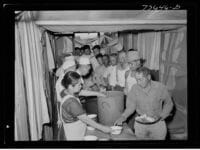
The cooperative mess hall at the Farm Security Administration camp in Nyssa, Oregon, July 1942. This photograph documents Japanese American civilians in a separate wartime program. Russell Lee, Library of Congress, LC-DIG-fsa-8c32471. [22]
The smaller camps and the California connection
A camp list compiled from Army population reports and other records identifies Pendleton, Athena, Stanfield, Milton-Freewater and the Umatilla Ordnance Depot in northeastern Oregon. It also lists branch sites at Bend and Camp Abbot near Sunriver, at Salem and Independence in the Willamette Valley, and at Vale in Malheur County. The compilation connects Milton-Freewater with work at the Rogers pea cannery. It lists Pendleton under Camp Lewis, Washington, and several Oregon branches under Rupert. Those assignments help explain why an Oregon camp may appear in the records of a base in another state. The listing establishes leads for local research; it does not give every site’s opening date, population or work assignments. [14]
The wartime names can obscure how close some sites were to one another and how far their administrative ties extended. A depot, an Army training post, a branch camp and a farm that received a day crew were different things. For example, a newspaper report about an escape from a hop farm confirms prisoners worked there. It does not establish that they slept there or that the Army classified it as a camp. A camp roster and a dated newspaper account answer different questions. [11][14]
One important destination lay across the California line. In 1944, Italian prisoners converted a former Civilian Conservation Corps camp at Tulelake for use as a POW compound. German prisoners began arriving there from Camp White in June. The National Park Service records a peak of about 800 German prisoners in October 1944. Their work included raising and harvesting potatoes and onions in the Tule Lake Basin. Camp Tulelake had previously held Japanese Americans and was a separate facility from the nearby Tule Lake Segregation Center. Its connection to Camp White makes it part of the Oregon story even though the camp itself was in California. [15]
The transfer to Tulelake took work before a single German crew could go out to a field. The National Park Service records that about 150 Italian prisoners arrived in May 1944 to prepare the site. They installed utilities and security infrastructure, including fences, guard towers and searchlights, while living in tents in town. In June, the German prisoners began to arrive from Oregon. The growers’ labor request had produced a construction assignment for one group of prisoners and agricultural assignments for another. [15]
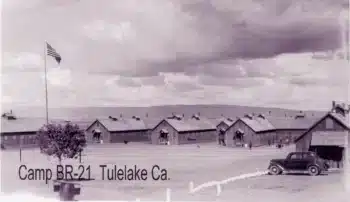
Camp Tulelake, California, in 1936, when it was a Civilian Conservation Corps camp. The site later served as a POW camp linked to Camp White. U.S. Fish and Wildlife Service photo, via the National Park Service. [23]
What prisoners could be made to do
The 1929 Geneva Convention permitted captors to employ physically fit prisoners according to rank and ability, with special rules for officers and noncommissioned officers. It barred work directly connected to military operations, including making or transporting arms and munitions, and prohibited unhealthy or dangerous work. The Oregon Historical Society’s account of the Tulelake operation records a prisoner work allowance of 80 cents a day. That allowance did not make a guarded assignment equivalent to civilian employment. [16][17]
The treaty distinguished among ranks. Officers could request work but could not be compelled to do it. Noncommissioned officers could generally be required only to supervise, unless they requested other paid employment. The treaty also required rest and set limits on the workday in relation to civilian workers doing similar work. Its rules tell us what captors were obliged to do; the Nyssa account, with its long day away from camp and travel time included, gives a glimpse of how a local officer described the schedule. [1][16]
Agricultural work was well established, but other proposals met resistance. Oregon Public Broadcasting traced an effort to use German prisoners to relieve the Northwest timber shortage. Officials considered the idea, but the logging proposal did not go forward. It belongs in the history of wartime labor debates, rather than on a list of jobs Oregon prisoners actually performed. [18]
The Army and civilian labor agencies also had to decide when prisoners could substitute for civilian workers. The Army’s official history describes certifications and contracts, rather than a general right for employers to call for prisoners. After the fighting ended, the War Department shortened the duration of contracts and asked the agencies involved to review which could be ended. The arrangement growers had come to rely on was already being dismantled while some still hoped to keep it. [19]
Why the camps stayed open after victory
The surrender in Europe ended the fighting against Germany, but the Army still had hundreds of thousands of prisoners in custody in the United States. The camps needed to be closed, prisoners moved, and overseas transport arranged. At the same time, growers and federal agriculture officials pressed to retain workers for crops they still had to harvest. The U.S. Army’s history records a 60-day deferment announced in January 1946 to ease shortages in industries including sugar beets. President Harry Truman declined to extend the program again, citing the availability of civilian workers and veterans looking for jobs. By the end of June 1946, the Army had repatriated nearly all prisoners still held in the United States, with exceptions for men serving penal sentences. [19]
The physical sites followed different paths. Camp White’s hospital buildings were reused for veterans’ care, and the camp’s core helped shape the industrial development of White City. At Camp Adair, much of the former cantonment became part of the E. E. Wilson Wildlife Area. The surviving foundations at Adair and the buildings at White are evidence of wartime mobilization and later reuse. Identifying a feature specifically as part of a POW compound takes a dated plan, a photograph or an account that fixes its location. [4][9]
For a family or local history researcher, the best starting point is usually a name or a dated place. The University of Oregon’s Historic Oregon Newspapers collection includes the Camp Adair Sentry and local papers that reported on harvest crews and escapes. Oregon State University’s guide to Camp Adair points to wartime maps, aerial photographs and engineering reports. A dated clipping can identify the job a crew performed; a map can show how the camp was laid out; a letter or memoir can supply a voice the official records leave out. [21][24][25]
The surviving record brings the scale of the war down to something a reader can see: a truck taking guarded men to a farm, a crate of kitchen utensils at Adair, a prisoner’s painting kept in a Rogue Valley home. For collectors and family historians, those objects and photographs can open a line of inquiry. A name, a date and a documented location can help distinguish a military prisoner from a civilian internee or an American soldier stationed at the same post. For a separate look at the identification carried by the U.S. soldiers who trained at camps like White and Adair, see WWII Dog Tags Explained.
Sources
[1] Nyssa Gate City Journal, May 10, 1945, front page
[2] U.S. Department of Veterans Affairs, World War II Allied Forces and Enemies
[3] National Archives, The Italian Service Units of World War II in Boston
[4] Oregon Encyclopedia, Camp White
[5] Oregon Humanities, Just People Like Us
[6] Medford Mail Tribune, August 9, 1945, front page
[7] Medford Mail Tribune, April 8, 1945, page 10
[8] Oregon Travel Information Council, Camp Adair historical marker
[9] National Park Service, Preserving the Historic Military Landscape at Camp Adair
[10] Oregon Statesman, May 5, 1945, front page
[11] La Grande Evening Observer, September 17, 1945, front page
[12] Capital Journal, August 2, 1945, page 13
[13] Oregon Encyclopedia, Oregon Plan
[14] Kathy Kirkpatrick, POW Camps in Oregon, compilation of military and local records
[15] National Park Service, Camp Tulelake
[16] Geneva Convention on Prisoners of War, 1929, Articles 27–34
[17] Oregon Historical Society, German POWs, 1944
[18] Oregon Public Broadcasting, How Nazi POWs Almost Became Loggers in Oregon and Washington
[20] Roseburg News-Review, July 24, 1944, front page
[21] Oregon State University SCARC, student research on Camp Adair and Willi Gross
[22] Library of Congress, Russell Lee photograph of the Nyssa cooperative mess hall
[23] National Park Service, National Park Getaway: Tule Lake National Monument
[24] Historic Oregon Newspapers, Camp Adair Sentry
[25] Oregon State University SCARC, Camp Adair local history collections guide