
In the final months of World War II, as Allied forces pushed deep into Germany, one last great airborne operation was launched over the Rhine. It was massive, fast-moving, and deadly. More than a dramatic parachute assault, it was the final large-scale airborne operation of the war in Europe. That mission was Operation Varsity.
On March 24, 1945, Allied airborne forces descended east of the Rhine in support of Operation Plunder, the broader effort to force a crossing into Germany’s industrial heartland. British and American airborne troops would seize key terrain, disrupt German defenses, and help open the road into the collapsing Third Reich. It was a battle fought in broad daylight under heavy fire, and it would prove both costly and decisive.
The Road to the Rhine
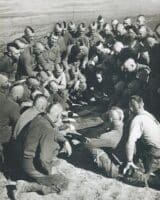 By the spring of 1945, Nazi Germany was under tremendous pressure. Soviet forces were driving in from the east while British, Canadian, and American armies closed in from the west. The Rhine River remained Germany’s last great natural defensive barrier. If the Allies could cross it in force, the final advance into the heart of Germany would begin.
Field Marshal Bernard Montgomery planned a major crossing in the north near Wesel. His ground assault, Operation Plunder, would send British and American troops across the Rhine with overwhelming artillery, air, and engineering support. But Montgomery wanted the assault to move faster and hit harder. To do that, he ordered an airborne drop behind German lines to seize roads, woods, and villages that could threaten the river crossing.
That airborne operation was named Varsity.
The Largest Single-Day Airborne Drop of the War
Operation Varsity was launched on March 24, 1945. It involved the British 6th Airborne Division and the U.S. 17th Airborne Division. Together, they formed one of the most powerful airborne assaults of the war.
Unlike the scattered nighttime drops seen in Normandy or the extended lifts of Operation Market Garden, Varsity was designed as a single concentrated blow. The troops would be dropped in daylight and in one main lift, close to the battlefield and closely tied to the progress of the ground crossing.
More than 16,000 airborne troops took part. They were delivered by a huge fleet of transport aircraft and gliders. Hundreds of C-47s and other transports filled the sky, towing gliders loaded with infantry, jeeps, anti-tank guns, ammunition, and supplies. It was one of the greatest aerial armadas ever assembled for an airborne mission.
Jumping Into Heavy Fire
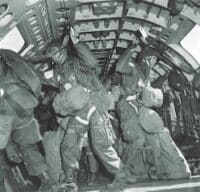 The scale of the drop was immense, but so was the danger. Because the operation took place in daylight and near a well-defended front, the German defenders were fully alert. Anti-aircraft guns opened up as the Allied formations approached the drop zones.
The sky over the Rhine became a wall of flak. Aircraft were hit. Gliders were torn apart or crashed violently on landing. Paratroopers jumped into fields already swept by machine-gun and artillery fire. Some landed in open ground with little cover. Others came down in wooded areas or close to enemy strongpoints. Casualties began before many men had even reached the ground.
Even so, the airborne troops pressed forward with remarkable speed. Small groups formed up where they landed, often mixing men from different units, and drove toward their objectives. The mission required them to capture key roads, villages, and high ground east of the Rhine and to prevent German reserves from organizing a counterattack.
Fighting for the Objectives
One of the most important areas in the battle was the Diersfordter Wald, a wooded area that gave the Germans concealment and defensive strength. Airborne troops fought hard to clear the forest and seize the terrain around it. Other units targeted bridges, artillery positions, and road junctions that German forces would need if they hoped to slow the Allied advance.
The fighting was often close and confused. Men who had trained for airborne warfare now had to prove themselves in some of the most dangerous conditions possible, landing under fire and attacking immediately. The glider troops faced especially brutal landings, as their aircraft crashed into fields and meadows under enemy fire, often taking casualties before they could even unload their equipment.
Still, the airborne troops did what they had been sent to do. They captured prisoners, overran defensive positions, and disrupted German plans at a critical moment in the battle.
Linking Up Across the Rhine
At the same time the airborne assault was underway, Allied ground forces were crossing the Rhine in Operation Plunder. Supported by artillery barrages, amphibious vehicles, assault boats, and engineering units, British and American troops forced their way across the river and expanded their bridgeheads.
Within hours, airborne troops east of the Rhine began linking up with the advancing ground forces. This was exactly what the planners had intended. German units defending the sector found themselves under pressure from two directions at once. Their front was broken, their rear areas were threatened, and their ability to organize resistance began to collapse.
The Rhine had been crossed, and the last major defensive barrier in western Germany had been breached.
The Cost of Success
Operation Varsity succeeded in taking its objectives and helping secure the Rhine crossing, but it came at a significant cost. The airborne forces suffered heavy casualties in a very short period of time. The daylight approach and concentrated German anti-aircraft fire made the flight in especially dangerous. Transport aircraft and gliders were lost, and many paratroopers and glider infantry were killed or wounded before the battle on the ground was even fully underway.
Yet despite those losses, the mission accomplished what it set out to do. The airborne assault helped prevent organized German resistance from stopping the crossing, and it accelerated the Allied breakout into northern Germany during the final weeks of the war.
Why Operation Varsity Mattered
Operation Varsity mattered because it showed how much Allied airborne warfare had evolved by 1945. The painful lessons of Sicily, Normandy, and Market Garden had not been forgotten. Planners concentrated the drop, improved coordination with ground forces, and ensured overwhelming Allied control of the air. The result was an airborne operation that, while costly, was tactically successful and directly tied to a major breakthrough on the ground.
It also marked the end of an era. Varsity was the final large-scale airborne assault of World War II. Within weeks, Allied armies were sweeping deeper into Germany, and the Third Reich was nearing total collapse. Germany would surrender in May 1945.
The Legacy of Operation Varsity
The men who jumped during Operation Varsity knew the war was entering its final chapter, but that did not make their mission any less dangerous. They boarded aircraft, crossed the Rhine under intense fire, and dropped into enemy territory to finish the war in Europe.
For American airborne troops, Varsity was another chapter in the legacy of the paratrooper. For British airborne forces, it was a final demonstration of discipline, courage, and offensive spirit. Together, these troops helped open the door into Germany and hasten the end of Nazi rule in Europe.
Operation Varsity deserves to be remembered not only for its scale, but for the men who carried it out. They were paratroopers and glider troops who faced flak, crash landings, and close combat with determination. They were part of the last great airborne assault of World War II, and their battle over the Rhine remains one of the defining moments in airborne history.
Remembering the Airborne Soldier
The story of Operation Varsity lives on through the history of the airborne divisions that fought there and through the personal artifacts those men carried into battle. Dog tags, jump wings, helmets, uniforms, and field gear all remain powerful reminders of the soldiers who crossed the Rhine from the sky.
Each item connects us to a man who took part in one of the war’s final and most dramatic assaults. Each name tells a story. And on March 24, 1945, thousands of those stories came together over Germany in the last great airborne operation of World War II.