
The war in Europe was only a few days old for the men fighting in Normandy when the first American nurses arrived. The invasion beaches were still crowded with equipment, the hedgerows were still hiding German troops, and artillery flashes could still be seen at night across the countryside.
Into that dangerous and uncertain environment came 2nd Lt. Suella Bernard, a young Army flight nurse whose job was not to fight the war, but to make sure the wounded had a chance to survive it.
Her aircraft did not bring bombs or paratroopers. Instead, it carried stretchers.
Bernard was part of a new kind of military medicine that had emerged during World War II — aeromedical evacuation, the rapid transport of wounded soldiers by aircraft from the battlefield to hospitals far behind the front.
It was a revolution in battlefield survival, and she was helping write the rules as the war unfolded.
Flying Into Normandy
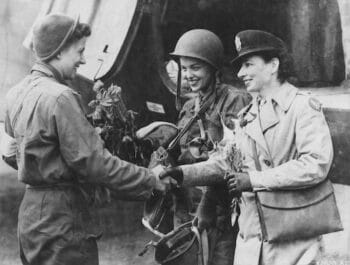
On June 10, 1944, just four days after the D-Day landings, a group of American flight nurses landed in France to begin evacuating wounded soldiers from the newly established Allied beachhead.
Among them was Suella Bernard.
The nurses arrived on transport aircraft flying from England to a hastily prepared landing strip in Normandy. The field was still close enough to the fighting that artillery could be heard nearby. Fighter aircraft circled overhead as protection while the transports loaded casualties.
For the wounded men waiting to leave the battlefield, the sight of an Army nurse stepping onto the tarmac was unforgettable.
Bernard and the other nurses moved quickly through rows of stretchers, checking bandages, administering morphine, and reassuring soldiers who had only hours earlier been fighting in the hedgerows of France.
Once the aircraft were loaded, the wounded were flown back across the English Channel to hospitals in Britain.
For many of those men, that flight meant the difference between life and death.
The Flight Nurses of World War II
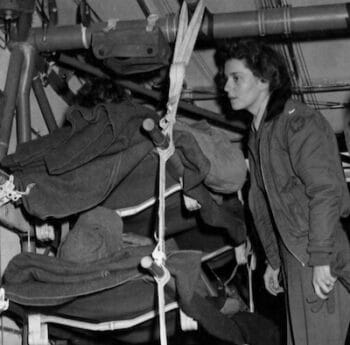 The Army Air Forces had begun developing medical evacuation units earlier in the war, but by 1944 the system had become one of the most important medical innovations of the conflict.
Flight nurses served as the airborne caretakers of wounded soldiers. Working inside noisy cargo aircraft, they monitored patients during the flight, controlled bleeding, treated shock, and kept the injured stable until they could reach a hospital.
Conditions were rarely comfortable.
Aircraft cabins were cold, loud, and cramped. Turbulence could send stretchers swinging. Many patients were suffering from severe trauma or burns.
Yet the system worked remarkably well.
By the end of the war, American air evacuation units had transported more than a million wounded patients, and the survival rate during flight was extraordinarily high.
Nurses like Suella Bernard were a major reason why.
The Mission at Remagen
By the spring of 1945, the war in Europe was nearing its end. American forces had crossed the Rhine River at Remagen, capturing the famous Ludendorff Bridge and establishing a bridgehead deep inside Germany.
The fighting in the area was intense, and large numbers of wounded soldiers were accumulating near the front.
A unique solution was proposed.
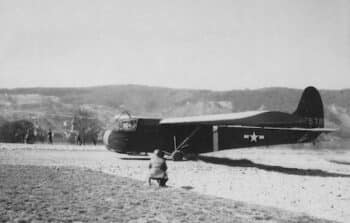
Two CG-4A gliders would land near the bridgehead, load severely wounded casualties, and then be lifted back into the air by a tow aircraft using a daring maneuver known as a snatch pickup.
It was an unusual and dangerous plan.
The gliders had no engines and little protection. Once on the ground, they would have to be loaded with wounded soldiers while still within range of enemy artillery. Then a C-47 transport aircraft would hook the tow rope and yank the glider into the air, carrying it back to safety.
When volunteers were requested for the mission, 1st Lt. Suella V. Bernard stepped forward.
Riding the Glider Out
On March 22, 1945, the gliders landed near the Remagen bridgehead and began loading casualties.
Inside the cramped fuselage, stretchers were secured along the walls with straps. The wounded included both American and German soldiers, many of them too badly injured to endure long ground transportation.
Bernard moved from stretcher to stretcher, checking bandages and comforting patients as the loading continued.
Soon the moment came for the most dangerous part of the mission.
The C-47 passed overhead and snagged the tow line attached to the glider. In an instant the aircraft yanked the glider forward, lifting it off the ground and pulling it into the air.
Inside the swaying fuselage, Bernard continued caring for the wounded as the glider climbed and began its flight toward a hospital in France.
The mission succeeded.
Twenty-five severely injured casualties were evacuated from the front lines.
For her role in the mission, 1st Lt. Suella V. Bernard received the Air Medal.
A Unique Place in WWII History
The Remagen mission would become one of the most unusual medical evacuations of the war.
Suella Bernard is believed to be the only nurse to participate in a combat glider evacuation mission during World War II.
But perhaps the more important part of her story is what it represents.
During the war, thousands of Army nurses served close to the front lines, working long hours under dangerous conditions to care for wounded soldiers.
They were not armed, and they rarely appeared in headlines.
Yet their work saved countless lives.
Remembering the Nurses Who Flew the Wounded Home
The story of 1st Lt. Suella V. Bernard is a reminder that courage during wartime often appears in unexpected places.
Sometimes it can be found in the cockpit of a transport plane flying into a newly captured beachhead.
Sometimes it can be found inside a fragile glider loaded with wounded men and lifted suddenly into the sky.
And sometimes it appears in the steady hands of a nurse who refuses to leave her patients behind.