

K. T. Stevens was born Gloria Wood on July 20, 1919, in Los Angeles, California, into a family where Hollywood was not a dream but a daily reality. Her father was famed director Sam Wood, responsible for classics such as Goodbye, Mr. Chips, A Night at the Opera, and For Whom the Bell Tolls. Her mother was a stage performer. From the beginning, Stevens was surrounded by scripts, rehearsal rooms, and the quiet pressure of legacy.
She appeared on screen before she could walk. At just two years old, she made her film debut as “Baby Gloria Wood” in her father’s silent-era production Peck’s Bad Boy (1921), sharing scenes with child star Jackie Coogan. Unlike many child actors of the era, Stevens did not burn out early. Instead, she grew into the profession deliberately, determined to earn her place rather than inherit it.
After high school, she committed fully to acting. She trained seriously, worked summer stock, and learned the discipline of live theater. In 1938, she toured nationally in productions of You Can’t Take It with You and My Sister Eileen, sharpening her craft in front of audiences far removed from Hollywood soundstages.
In 1939, she stepped onto Broadway with a walk-on role in Summer Light, directed by Lee Strasberg. By this point, she had shed her birth name. First billing herself as Katharine Stevens—in homage to Katharine Hepburn—she eventually refined it to K. T. Stevens. The initials were deliberate: modern, slightly mysterious, and free of her father’s shadow.
Broadway, Radio, and the War Years
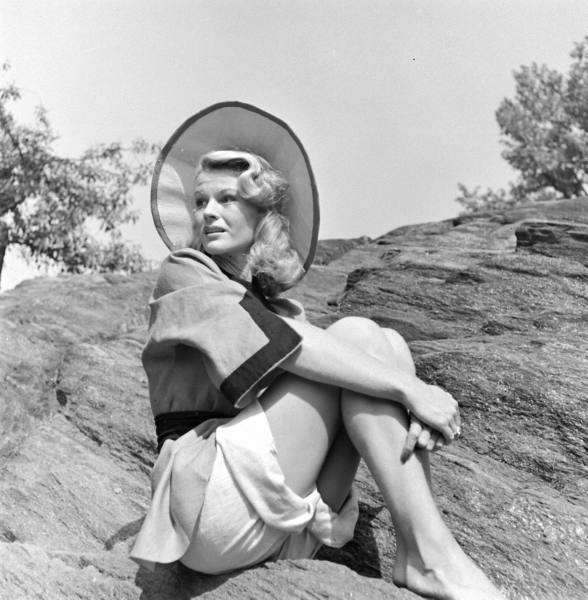 As World War II reshaped American life, K. T. Stevens found her strongest footing not in film, but on Broadway and radio. During the early 1940s, she built a reputation as a dependable and compelling stage actress with appearances in The Man Who Came to Dinner (1940), Yankee Point (1942), and Nine Girls (1943).
Radio further expanded her reach. Like many actresses of the era, Stevens’ voice carried into homes, factories, and military barracks across the country. During wartime, radio stars and pin-up imagery were inseparable parts of American morale, and Stevens’ poised delivery and wholesome glamour fit the moment perfectly.
Her film appearances during this period were limited but notable. She appeared in Kitty Foyle: The Natural History of a Woman (1940), directed by her father and starring Ginger Rogers, followed by The Great Man’s Lady (1942) alongside Barbara Stanwyck. With her clear features and expressive eyes, Stevens seemed a natural fit for film noir—but Hollywood never fully capitalized on that promise.
Stage Romance and a Shared Career
In 1941, while appearing in the Broadway production The Land Is Bright, Stevens met actor Hugh Marlowe. The two shared an immediate professional chemistry. After co-starring in a 1944 Chicago staging of The Voice of the Turtle, they married in 1946.
For the next decade, Stevens and Marlowe became one of the theater world’s most reliable partnerships, appearing together in more than twenty stage productions. Among the most memorable was a Broadway adaptation of Laura, with Stevens as the elusive Laura Hunt and Marlowe as the detective consumed by her—a casting that blurred the line between fiction and real life.
Film Noir Edges and Television Longevity
Although she never achieved top-tier film stardom, Stevens left lasting impressions in Port of New York (1949) opposite Yul Brynner, Vice Squad (1953) with Paulette Goddard, and the cult science-fiction feature Missile to the Moon (1958). She brought credibility and restraint to every role, even when the material was modest.
As television rose to dominate American entertainment, Stevens transitioned smoothly. Throughout the 1950s and 1960s, she appeared on series such as Perry Mason, Alfred Hitchcock Presents, and The Big Valley. Later, she found renewed visibility in daytime television, most notably on The Young and the Restless beginning in 1973.
Life After the Limelight
Following her 1967 divorce from Marlowe, Stevens stepped away from acting for a time, choosing a quieter life teaching nursery school. It was an unexpected turn for a woman raised in Hollywood, but one that reflected her independence and lack of attachment to fame.
She eventually returned to television and became a respected advocate for performers, serving three terms as President of the Los Angeles local branch of AFTRA. She was also the mother of two sons: Jeffrey, born in 1948, and Christian, born in 1951—known today as sportscaster Chris Marlowe.
Final Curtain
K. T. Stevens died of lung cancer on June 13, 1994, at the age of 74.
She was never the loudest name on the marquee, but she didn’t need to be. Like many women of the World War II era, Stevens built a career on professionalism, adaptability, and quiet determination. Her image—elegant, composed, and unmistakably of her time—remains a reminder that wartime glamour often lived just beyond the spotlight.