
What Does the “D” in D-Day Mean?
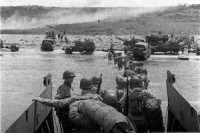 Few military terms are more famous than D-Day. For most Americans, the phrase immediately brings to mind June 6, 1944, when Allied troops stormed the beaches of Normandy in Operation Overlord.
But Normandy was not the first D-Day, and it was not the only one.
A common belief is that the “D” stands for disembarkation or debarkation, referring to Allied troops leaving landing craft and coming ashore. Others have suggested more dramatic meanings such as decision, deliverance, or doom. These explanations are memorable, but they are not correct.
In military usage, the “D” in D-Day simply stands for day. Likewise, the “H” in H-Hour stands for hour.
Why the Military Used D-Day and H-Hour
Large military operations require detailed planning across many units, ships, aircraft, supply columns, and command posts. Planners must coordinate what happens before, during, and after the opening moment of an attack.
Instead of assigning every action to a fixed calendar date, planners used relative time. The day the operation began became D-Day. The hour it began became H-Hour.
This made planning flexible. If weather, logistics, or enemy action delayed the operation, commanders did not need to rewrite every order. The schedule simply shifted around D-Day and H-Hour.
- D-3 meant three days before the operation.
- D+1 meant one day after the operation began.
- H-2 meant two hours before the opening assault.
- H+75 meant seventy-five minutes after the attack started.
This system was especially useful for amphibious operations, airborne drops, naval bombardments, and large ground offensives involving thousands of men moving on a coordinated timetable.
The First Known American D-Day
 The best-known D-Day was Normandy, but the term was used earlier. One of the earliest known American uses came during World War I, on September 7, 1918, in orders for the St. Mihiel Offensive.
The order stated that the First Army would attack at H-Hour on D-Day with the objective of forcing the evacuation of the German-held St. Mihiel Salient.
The attack began on September 12, 1918. It was the first major offensive launched entirely by American forces during the war. The operation succeeded quickly, aided by German withdrawal plans already underway and by aggressive American leadership.
Patton and MacArthur at St. Mihiel
A famous story from the St. Mihiel campaign involves two men who would later become legendary in World War II: George S. Patton and Douglas MacArthur.
During the battle, then-Lieutenant Colonel Patton encountered Brigadier General MacArthur on a hilltop. While the two officers spoke, German artillery began creeping closer. Neither man wanted to appear afraid in front of the other, so both remained in place as the barrage passed nearby.
Both men survived, and both would later become among the most recognized American commanders of the Second World War.
Why Normandy Became “The” D-Day
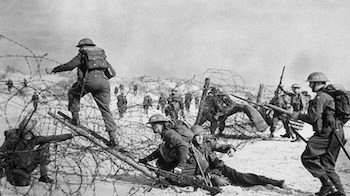 Although D-Day was a planning term, June 6, 1944 gave it permanent meaning in public memory.
On that morning, Allied forces landed on five Normandy beaches:
- Utah Beach
- Omaha Beach
- Gold Beach
- Juno Beach
- Sword Beach
American, British, Canadian, Free French, Polish, and other Allied forces took part in the operation. Airborne troops from the 82nd Airborne Division, 101st Airborne Division, and British 6th Airborne Division landed before dawn to secure bridges, roads, and exits behind the beaches.
The scale of Operation Overlord was so enormous that the term D-Day became permanently attached to Normandy. In popular language, “D-Day” now usually means June 6, 1944, even though military planners used the term for many operations.
The Other D-Days of World War II
Because Operation Overlord was so large, Allied planners often used different lettered designations for other major operations to avoid confusion.
A-Day — Leyte, Philippines
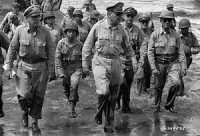 A-Day marked the start of the Allied landing on Leyte in the Philippines on October 20, 1944.
This operation fulfilled General Douglas MacArthur’s famous promise: “I shall return.” MacArthur waded ashore at Leyte after more than two years of fighting to return to the Philippines following the Japanese conquest of 1942.
 L-Day — Okinawa
 L-Day — Okinawa
L-Day referred to the landing on Okinawa on April 1, 1945.
Okinawa became one of the bloodiest battles of the Pacific War. It was the last major amphibious assault of World War II and placed Allied forces within striking distance of the Japanese home islands.
Z-Day — Brunei and North Borneo
Z-Day was used for the landing of Australian forces at Brunei in North Borneo on June 10, 1945.
The operation helped liberate territory held by Japan and secured important oil and port facilities in the final months of the Pacific War.
J-Day — Assault Planning Term
J-Day was used as a general planning term for the date of a specific assault in both world wars. Like D-Day, it allowed commanders to build plans around a relative start date rather than a fixed calendar day.
Q-Day — Trinity Rehearsal
Q-Day was used for the June 23, 1945 rehearsal connected to Trinity, the first atomic bomb test.
The use of a lettered day in this context shows how widely the military applied the system beyond amphibious landings alone.
X-Day and Y-Day — The Planned Invasion of Japan
X-Day was the planned start date for the invasion of southern Japan, scheduled for November 1, 1945, as part of Operation Olympic.
Y-Day was the planned invasion of the Tokyo Plain, scheduled for March 1, 1946, as part of Operation Coronet.
These operations were never carried out because Japan surrendered in August 1945 after the atomic bombings of Hiroshima and Nagasaki and the Soviet declaration of war against Japan.
D-Day Was a Planning Tool Before It Became a Legend
D-Day became legendary because of Normandy, but its original meaning was practical. It was a tool for soldiers, sailors, airmen, and planners who needed to coordinate complicated operations under uncertain conditions.
The “D” did not mean doom, deliverance, decision, or disembarkation. It meant day — the day the operation began.
That simple planning term became one of the most powerful phrases in military history because of what happened on the beaches, in the skies, and behind the lines of Normandy on June 6, 1944.