
1940 — Wartime Restrictions Tighten in France
As fears of internal unrest grow during the “Phoney War,” the French government declares the spreading of Communist or antiwar propaganda to be a capital offense.
The measure reflects mounting anxiety across Europe as governments struggle to maintain national unity while preparing for the widening conflict.
1941 — Rommel Captures Benghazi
 Axis Forces Retake Benghazi
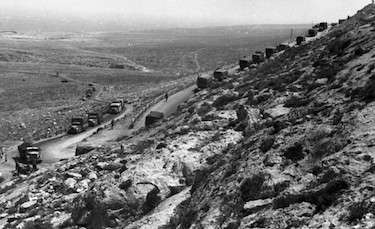 Axis Forces Retake Benghazi
General Erwin Rommel and the German Afrika Korps capture the strategic Libyan port city of Benghazi from British forces.
The rapid Axis advance catches the British off balance and marks another dramatic success for Rommel’s aggressive desert campaign. British forces continue retreating eastward toward Egypt as the Germans regain much of the territory lost by Italy earlier in the war.
Rommel’s bold maneuver warfare in North Africa begins earning him a reputation that will later lead to the nickname “The Desert Fox.”
Italians Abandon Addis Ababa
Italian forces evacuate Addis Ababa, the capital of Ethiopia, as Allied troops continue their successful East African Campaign.
The withdrawal signals the collapse of Italian control in Ethiopia and the gradual dismantling of Mussolini’s East African empire.
1943 — Expansion of Auschwitz Killing Facilities
A newly completed gas chamber and crematorium, known as Crematorium V, becomes operational at Auschwitz.
The expansion increases the camp’s already horrifying capacity for mass murder as the Holocaust intensifies across occupied Europe.
1944 — Fighting Across Europe and Burma
De Gaulle Takes Command of Free French Forces
Charles de Gaulle becomes commander of the Free French Armed Forces, replacing General Henri Giraud.
The move consolidates de Gaulle’s political and military authority as Free French forces prepare to participate in the liberation of France.
German Counterattack at Kovel
Army Group Centre, commanded by General Ernst Busch, launches a counterattack in the Pripet Marshes.
The offensive succeeds in reaching German units surrounded near Kovel since March 19, temporarily stabilizing part of the Eastern Front.
Retreat to Imphal
The British 17th Indian Division reaches the Imphal Plain after an exhausting twenty-day fighting retreat through Burma.
Japanese forces launch major offensives aimed at capturing Imphal and Kohima, initiating one of the most critical campaigns of the Burma War.
The coming battles will become turning points in the Allied struggle against Japan in Southeast Asia.
1945 — Allied Victory Nears in Europe
American and British Advances Continue
The U.S. Third Army advances toward Leipzig, capturing the German cities of Suhl and Gotha, while finally eliminating remaining German resistance in Kassel.
Further north, the British Second Army captures Osnabrück, and the French First Army enters Karlsruhe.
Soviet Breakthrough Toward Stettin
The Soviet 1st Belorussian Front breaks through German defenses at Stargard and advances toward Stettin.
Soviet forces also establish a new bridgehead across the Oder River south of Frankfurt, tightening pressure on Berlin.
Massive Bombing Raid on Kiel
The U.S. Eighth Air Force launches its heaviest raid to date against the Baltic port city of Kiel.
Approximately 700 bombers attack shipyards, naval facilities, and transportation targets critical to the German war effort.
Liberation of Ohrdruf Concentration Camp
Troops of the U.S. Third Army liberate the Ohrdruf concentration camp, the first Nazi concentration camp liberated by American forces.
American soldiers are shocked by the evidence of brutality, starvation, and mass death discovered at the site.
The liberation of Ohrdruf provides some of the earliest direct evidence to Western Allied troops of the horrors of the Nazi camp system.
Soviets Complete Liberation of Hungary
The Soviet 2nd and 3rd Ukrainian Fronts complete the liberation of Hungary from German control.
Troops of the 2nd Ukrainian Front capture Bratislava, while German forces launch counterattacks near Moravská Ostrava and Nitra in a final attempt to slow the Soviet advance into Central Europe.