
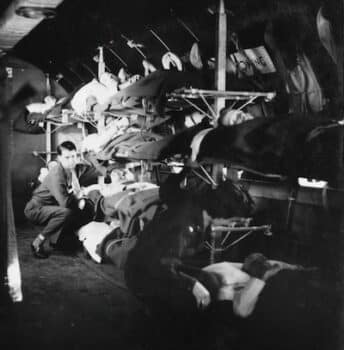
 The cargo plane droned steadily across the English Channel. Inside the dim fuselage, rows of stretchers were secured along the walls. Many of the men lying on them had been wounded only hours earlier on the beaches of Normandy.
Moving carefully through the narrow aisle was an Army nurse in flight gear. She checked bandages, adjusted blankets, and leaned close to speak to a young soldier who was trying to stay awake.
Outside the aircraft windows, the war still raged. But inside that transport plane, a different battle was being fought — the battle to keep wounded men alive long enough to reach a hospital.
The woman caring for them was one of the flight nurses of World War II, part of a revolutionary system that changed military medicine forever.
A New Kind of Battlefield Medicine
Before World War II, wounded soldiers were usually evacuated from battlefields by ambulance, truck, or train. These methods could take days, and many men died before reaching proper medical treatment.
The U.S. Army Air Forces changed that system with the creation of aeromedical evacuation units.
Instead of waiting for ground transport, wounded soldiers could now be placed aboard transport aircraft and flown directly to rear hospitals. The system required specially trained medical personnel who could care for patients during flight.
That responsibility fell to Army flight nurses.
The Women Who Flew with the Wounded
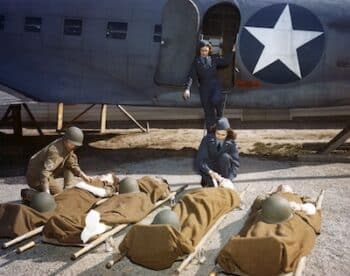 By the middle of the war, roughly 500 Army nurses had become flight nurses assigned to medical evacuation squadrons around the world.
They flew aboard aircraft such as:
-
C-47 Skytrains
-
C-54 Skymasters
-
Other transport aircraft adapted for casualty evacuation
Inside these aircraft, nurses cared for patients who were often suffering from severe trauma, burns, or shock. They monitored vital signs, administered medication, controlled bleeding, and kept wounded soldiers stable during the flight.
Conditions were rarely easy.
Transport aircraft were cold and noisy. Turbulence could shake stretchers loose. Some flights crossed combat zones where enemy fighters or anti-aircraft fire were still a threat.
Yet the system proved incredibly effective.
During World War II, American aeromedical evacuation units transported more than one million wounded patients, with an extraordinarily low death rate during flight.
Normandy and the Front Lines
Flight nurses often worked closer to combat than many civilians realized.
Within days of the D-Day invasion, flight nurses were already landing in Normandy to evacuate wounded soldiers from newly built airstrips near the beachhead.
Among those nurses was 2nd Lt. Suella Bernard, one of the first American nurses to land in France after the invasion. Missions like hers brought wounded soldiers out of the combat zone and delivered them to hospitals in England.
For thousands of men, that flight meant survival.
Courage Without a Rifle
Flight nurses carried no weapons. Their tools were medical kits, morphine syrettes, and determination.
But their courage was no less real.
They flew through storms, across oceans, and into active war zones to make sure the wounded had a chance to live.
For many soldiers, the first reassuring voice they heard after leaving the battlefield belonged to an Army nurse kneeling beside their stretcher.