
1938 — The Anschluss of Austria
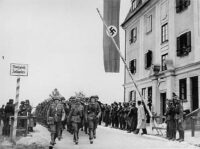 German troops cross the border into Austria without resistance, completing the Anschluss — the political union of Austria with Nazi Germany. Adolf Hitler, himself Austrian-born, declares that Austria has returned to the German Reich. The takeover occurs without a single shot being fired as German forces are greeted by large pro-Nazi crowds in Vienna and other cities.
The annexation violates the Treaty of Versailles and the Treaty of Saint-Germain but is met with little immediate opposition from Western powers. The Anschluss significantly strengthens Germany by adding Austrian manpower, industry, and strategic territory to Hitler’s rapidly expanding Third Reich.
1940 — The Winter War Ends
A peace treaty between Finland and the Soviet Union formally ends the brutal Winter War, which began in November 1939 when Soviet forces invaded Finland.
The treaty imposes harsh terms on Finland. The country is forced to surrender the entire Karelian Isthmus, including the important city of Viipuri, which the Soviets rename Vyborg. Additional territories ceded include parts of eastern Karelia, areas along Lake Ladoga, the Rybachiy Peninsula, and the Petsamo region.
Finland must also grant the Soviet Union a 30-year lease on the Hangö Peninsula, providing Moscow with a naval base near the entrance to the Gulf of Finland. Despite these severe territorial losses, Finland preserves its independence — something the Soviet Union had originally sought to eliminate.
Allied Plans for Norway
Meanwhile, the British government finalizes plans for a possible invasion of Norway. The objective is to secure the vital iron-ore supply routes from Sweden that pass through the Norwegian ports of Narvik and Trondheim. These resources are crucial for the German war industry.
1941 — Luftwaffe Devastates Clydebank
Prime Minister Winston Churchill publicly thanks the United States for its growing support of Britain, describing American assistance as a “new Magna Carta” in the struggle against Nazi Germany.
On the same night, the Luftwaffe launches a devastating bombing raid on Clydebank, Scotland, a major shipbuilding and industrial center near Glasgow. The bombing leaves approximately 75 percent of the town’s population homeless and causes widespread destruction of homes, factories, and infrastructure.
1942 — War Expands Across the Pacific and Arctic
Arctic Convoys Reach Murmansk
The Allied convoy PQ-12 successfully reaches the Soviet port of Murmansk without losses. It becomes the last of the Arctic convoys to arrive unscathed before German air and submarine attacks begin inflicting heavy losses on future shipments.
British Withdraw from the Andaman Islands
British forces evacuate their garrison from the Andaman Islands in the Bay of Bengal as Japanese forces continue their rapid expansion across Southeast Asia.
United States Occupies New Caledonia
American troops occupy New Caledonia, a strategically important island in the South Pacific. The island becomes a major Allied base for operations against Japanese positions throughout the region.
1943 — Strikes, Promotions, and Medical Breakthroughs
German Withdrawal from Vyazma
German forces evacuate the city of Vyazma west of Moscow as Soviet offensives continue pushing Axis troops back along the Eastern Front.
First Aeromedical Evacuation Mission
In North Africa, the U.S. 802nd Medical Air Evacuation Transport Squadron conducts its first mission using specially trained flight nurses to transport wounded soldiers by aircraft. This innovation dramatically improves survival rates for injured troops.
Patton Promoted
American armored commander George S. Patton is promoted to the rank of Lieutenant General, recognizing his leadership during the North African campaign.
Workers Strike in Fascist Italy
In a rare act of defiance inside a totalitarian regime, approximately 50,000 Italian industrial workers go on strike against the Fascist government of Benito Mussolini. The strikes disrupt wartime production and reflect growing discontent within Italy.
1944 — Sweden Investigates a “Flying Torpedo”
Swedish authorities announce an investigation into a mysterious object that crashed on Swedish territory. The object is believed to be a German experimental weapon known as a V-1 “flying bomb”, launched from a nearby German testing facility roughly forty miles away.
1945 — Final Months of the War
Massive RAF Raid on Dortmund
RAF Bomber Command sets another record for the largest tonnage dropped on a single target when 4,851 tons of bombs are unleashed against the German industrial city of Dortmund. The raid causes widespread destruction across the city.
 Anne Frank Dies at Bergen-Belsen
 Anne Frank Dies at Bergen-Belsen
Anne Frank, the young Jewish diarist whose writings documented life in hiding under Nazi occupation, dies of typhus in the Bergen-Belsen concentration camp at the age of fifteen. Her diary would later become one of the most powerful personal accounts of the Holocaust.