
1939 – War Expands Across Europe and the North Atlantic
The first Canadian troop convoy, TC-1, arrives safely at Liverpool, marking a major milestone in Canada’s overseas commitment to the Allied war effort.
In Eastern Europe, Lavrenti Beria, head of the NKVD, orders the start of large-scale deportations of Polish civilians to the Soviet Union—an act that will devastate countless families.
On the frozen northern front, the Finnish 40th Infantry Regiment of the Lapland Group forces the Soviet 273rd Infantry Regiment of the 9th Army to retreat at Pelkosenniemi, continuing Finland’s determined resistance during the Winter War.
In the air war, the RAF launches another daylight raid against German shipping in the Schillig Roads. The cost is severe—12 of 24 bombers are lost.
This marks the culmination of costly daylight operations and accelerates the RAF’s shift to
night bombing to reduce casualties.
1940 – Hitler Confirms Plans to Invade the Soviet Union
Adolf Hitler issues Directive No. 18, formally confirming plans for Operation Barbarossa, previously known as Operation Otto.
The objective is the destruction of the Red Army in western Russia before advancing on Moscow.
All preparations are ordered to be completed by May 15, 1941, setting the stage for the largest invasion in military history.
1941 – Power Consolidated and New Fronts Opened
Field Marshal Walther von Brauchitsch resigns as head of the German Army High Command (OKH).
Hitler accepts the resignation and assumes personal command of the Army and all operations on the Eastern Front.
Hitler also dismisses Army Group Centre commander Field Marshal von Bock, replacing him with Field Marshal von Kluge.
 In response, Joseph Stalin creates the Bryansk Front, positioned between the Western and Southwestern Fronts to strengthen the southern arm of the planned
double envelopment of Army Group Centre.
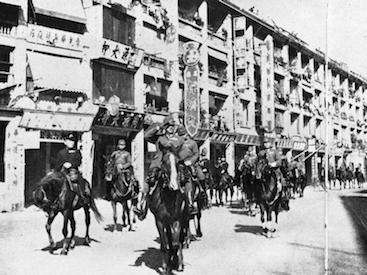
In the Far East, Japanese troops force landings on Hong Kong Island, bringing the battle directly into the colony’s urban heart.
Britain Mobilizes Women for War
In Britain, all unmarried women aged 20 to 31 are conscripted for national service—the first compulsory military service for women in any country.
They are required to choose between the ATS, WRNS, WAAF, Civil Defence, the Land Army, or war industry work.
U.S. Expands Presidential War Powers
The U.S. Congress passes the First War Powers Act, granting the President authority to reorganize government agencies and impose censorship on mail and communications during wartime.
1942 – Submarine Warfare in the Pacific
The U.S. submarine Albacore sinks the Japanese light cruiser Tenryu off New Guinea, delivering a sharp blow to Japanese naval forces.
American troops also land on Musita Island near Buna, expanding Allied pressure in New Guinea.
1943 – Justice in the East
The so-called Kharkov Four are sentenced to death, concluding one of the earliest war crimes trials conducted by Soviet authorities.
1944 – Battle of the Bulge and Disaster at Sea
Germany’s Ardennes offensive, Operation Wacht am Rhein, begins to bog down as U.S. resistance stiffens.
Severe shortages—particularly fuel—cripple the armored Kampfgruppen of the 6th SS Panzer Army and the 5th Panzer Army.
In Asia, 84 B-29 bombers of the U.S. 20th Bomber Command carry out their first mass incendiary raid, devastating the Japanese-held city of Hankow, China.
At sea, a powerful typhoon strikes near Samar, devastating the U.S. Third Fleet.
The destroyers USS Hull, USS Monaghan, and USS Spence are lost, with a combined death toll exceeding 770 sailors. Only 91 men survive from all three ships.