
A day marked by repression, shifting fortunes on the Eastern Front, deepening Allied involvement, and the steady expansion of the war across continents.
1939 – Terror in Occupied Poland and the First Major Air Battle
In Kraków, the Gestapo launched a brutal sweep of Poland’s intellectual community.
183 professors from the Jagiellonian University were arrested and transported to Sachsenhausen concentration camp near Berlin.
This deliberate targeting of scholars and cultural leaders was part of Germany’s wider effort to destroy Polish identity and leadership.
In the Soviet-occupied eastern territories, tragedy struck when Ukrainian peasants—after offering shelter and food—murdered
200 Polish refugees. The violence reflected the brutal fragmentation and ethnic tension unleashed by dual occupation.
Meanwhile, the first major air battle on the Western Front erupted in the skies, marking a new phase of aerial warfare between Allied and German forces.
1940 – Strengthening the Home Front and Supporting Allies
In Britain, the Under-Secretary for War announced that the Home Guard would receive improved equipment and a more permanent
organization—while maintaining its “local and friendly character.” The citizen army was becoming a more formidable defensive force.
Britain also extended critical financial support to Greece, beginning with a £5 million advance as Greece continued its struggle
against Italian aggression in the Balkans.
At sea, the Royal Canadian Navy destroyer Ottawa and Royal Navy destroyer Harvester sank the Italian submarine
Faa di Bruno off the coast of Ireland—another blow to Axis submarine operations in the Atlantic.
1941 – Winter Tightens and Conflict Expands
 As winter clamped down on the Eastern Front, Stalin claimed that Axis casualties had reached 4.5 million—a figure far above reality,
with actual losses around 700,000.
Yet the cold was proving just as deadly as Soviet bullets: the first cases of frostbite were being recorded in the German Army,
a grim sign of the hardships to come.
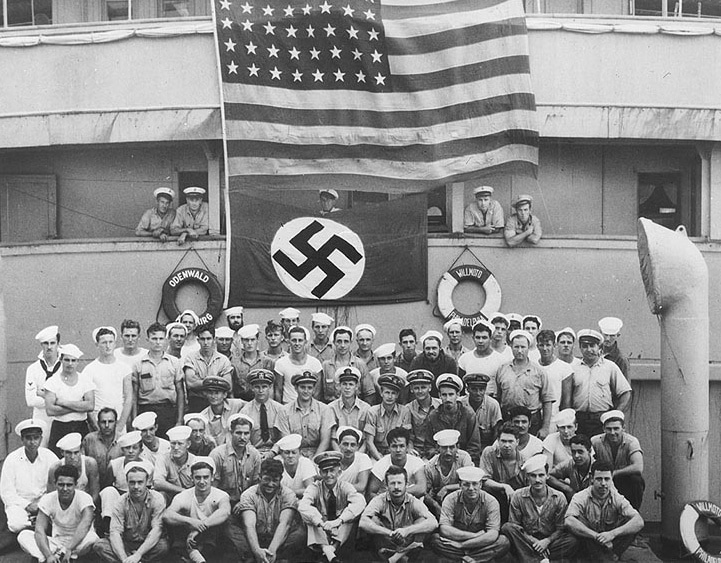
In the Atlantic, the German blockade runner Odenwald, disguised as a U.S. merchant ship, was captured by the cruiser
USS Omaha and destroyer USS Somers. The ruse failed under close inspection, giving the U.S. Navy a symbolic early victory.
In Asia, Japan’s Southern Army was ordered to prepare detailed operational plans for the coming offensive—a prelude to the attack on
Pearl Harbor and simultaneous assaults across Southeast Asia.
The United States extended a massive $1 billion interest-free loan to the Soviet Union, further cementing the growing connection between Washington and Moscow as the global conflict expanded.
1942 – Crisis in the Caucasus and Growing Soviet Demands
In the Caucasus, the German 13th Panzer Division found itself fighting desperately near Ordshonikidze, struggling to avoid encirclement as Soviet forces attacked from multiple directions. The German drive toward the oil fields was faltering.
Addressing the Congress of Soviet Deputies, Stalin issued a stern warning to the Western Allies.
Without a second front against Nazi Germany, he argued, “the absence of a second front may end badly for all freedom-loving countries, including the Allies themselves.”
He framed the Allied cause as a struggle to prevent humanity from “reverting to savagery and medieval brutality.”
Farther west in North Africa, the British Eighth Army made further gains, claiming another 20,000 Axis prisoners as German and Italian forces continued their retreat.
1943 – Victory in Kiev and Pressure Across Europe
Soviet forces achieved a major breakthrough by capturing Kiev and splitting the German Fourth Panzer Army into three parts,
deepening the crisis for German command on the Eastern Front.
In the Pacific, Japanese forces landed reinforcements north of Empress Bay, attempting to bolster defenses against mounting Allied pressure.
In the Netherlands, the German garrison at Middelburg surrendered—an important step in clearing the Scheldt estuary and securing Allied access to the port of Antwerp.
1944 – Yugoslav Gains and Advances in Burma
Tito’s partisan forces captured Monastir in southern Yugoslavia, completing control of the border with Greece.
The victory solidified the partisans’ position as one of the most effective resistance movements in Europe.
In northern Burma, the Chinese 22nd Division crossed the Irrawaddy River, continuing the Allied advance through the
region toward reopening the land route to China.
1945 – A New Nuclear Age and a New Era in Aviation
Soviet Foreign Commissar Vyacheslav Molotov announced that the USSR would soon possess the atomic bomb—a statement
that signaled the dawn of a new geopolitical reality and the early contours of the Cold War.
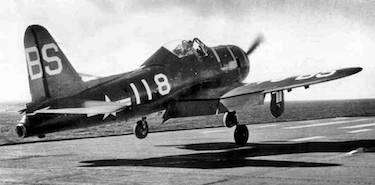
A milestone in naval aviation occurred aboard the USS Wake Island, where an FR-1 Fireball made the
first successful landing of a jet aircraft on a carrier—ushering in a new era of jet-powered naval operations.
Remembering November 6
From the repression of scholars in Kraków to clashes in the Caucasus, from partisan victories in Yugoslavia to the world’s uneasy
entrance into the nuclear age, December 1 offers a vivid portrait of a world in turmoil—fighting, advancing, and reshaping itself
in ways that would define the century to come.
Lest we forget.