
1940 – Finland Seeks Peace as Fighting Intensifies at Viipuri
Heavy fighting is reported on the outskirts of Viipuri (Vyborg) as the Soviet Red Army continues its determined attempt to capture the strategic Finnish city during the final days of the Winter War. Soviet forces have launched massive assaults supported by artillery and armor, overwhelming the exhausted Finnish defenders who have fought fiercely for months against a far larger army.
The deteriorating military situation forces the Finnish government to reconsider its position. Recognizing that continued resistance may lead to the collapse of their defenses entirely, Finnish leaders seek an immediate armistice with the Soviet Union. Moscow refuses the proposal for a ceasefire, insisting instead on full negotiations for peace under Soviet terms.
As a result, the Finnish delegation already present in Moscow is instructed to begin formal discussions aimed at ending the war. These negotiations will soon lead to the Moscow Peace Treaty, which ultimately ends the conflict but requires Finland to cede significant territory to the Soviet Union.
1941 – Lend-Lease Bill Passes the U.S. Senate
The United States Senate passes the historic Lend-Lease bill by a vote of 60 to 31. The legislation allows the United States to supply military equipment, food, raw materials, and other vital resources to countries fighting against the Axis powers without immediate payment.
The program becomes one of the most significant acts of American support for the Allied war effort prior to direct U.S. entry into World War II. Through Lend-Lease, Britain, China, and eventually the Soviet Union receive enormous quantities of war material including aircraft, tanks, trucks, ammunition, and industrial supplies.
The bill represents a decisive shift in American policy from strict neutrality toward active support for nations resisting Nazi Germany and Imperial Japan.
1941 – Martial Law Declared in the Netherlands
German occupation authorities proclaim martial law in the Netherlands in an effort to suppress growing anti-Nazi protests and acts of resistance. The declaration follows strikes and demonstrations sparked by German persecution of Dutch Jews and the increasing brutality of the occupation regime.
The move allows German authorities to impose harsh security measures, including curfews, arrests, and military enforcement. Despite these measures, Dutch resistance activity will continue throughout the war, eventually developing into a widespread underground network assisting Allied intelligence and protecting persecuted civilians.
1942 – RAF Uses GEE Navigation System in Essen Raid
During a bombing raid on the industrial city of Essen in Germany’s Ruhr region, the Royal Air Force uses the GEE navigation system for the first time in a target-marking role. GEE is a revolutionary radio navigation aid that allows bomber crews to determine their position more accurately at night or in poor weather.
The raid employs a technique known as “Shaker,” in which lead aircraft mark the target area with flares. Following bombers then use the illuminated markers to identify the aiming point and drop their bombs more accurately.
Despite the new technology, the results of the raid prove disappointing. Bombing accuracy remains limited, highlighting the challenges of night bombing and the need for further improvements in navigation and target marking techniques.
1942 – Rangoon Falls to the Japanese
Japanese forces capture the important port city of Rangoon in Burma, dealing a severe blow to Allied defenses in Southeast Asia. British and Commonwealth troops withdraw northward to avoid encirclement as Japanese forces rapidly advance through the region.
At this stage of the campaign, the British 17th Indian Division attempts to hold defensive positions along the Irrawaddy River while the 1st Burma Division occupies positions in the upper Sittang Valley. Meanwhile, Chinese Expeditionary Forces have entered Burma to assist in the defense.
The Fifth Chinese Army defends Mandalay while the Sixth Chinese Army holds positions around Toungoo and the Shan region. Despite these efforts, Japanese momentum continues to grow as the Burma campaign intensifies.
1942 – Japanese Landings in New Guinea
Japanese forces conduct unopposed amphibious landings at Lae and Salamaua on the northeastern coast of New Guinea. These strategic positions allow Japan to extend its defensive perimeter deeper into the Southwest Pacific.
The landings threaten Allied control of the region and place Japanese forces closer to Australia. Over the coming months, fierce fighting will erupt across New Guinea as Allied forces attempt to halt the Japanese advance.
1942 – Dutch Forces on Java Surrender
Dutch colonial forces on the island of Java surrender to the Japanese after weeks of intense fighting. The fall of Java effectively ends organized Allied resistance in the Dutch East Indies.
Japan gains control of vital oil resources and strategic territory across Southeast Asia, greatly strengthening its war economy and military position in the Pacific.
1943 – German Women Protest Nazi Deportations
In Berlin, more than one thousand German women whose husbands are Jewish gather in protest against the deportation of their spouses to concentration camps. The demonstration takes place in the Rosenstrasse district and becomes one of the most remarkable public protests against Nazi policies within Germany.
Fearing that the protests might spread and spark broader civil unrest, Propaganda Minister Joseph Goebbels orders the release of approximately 1,500 Jewish men who had been detained for deportation.
The event remains one of the rare instances during the Nazi regime where public protest resulted in the reversal of a policy decision.
1943 – Battle for Hill 700 Begins on Bougainville
Japanese forces launch a determined attack against American troops defending Hill 700 on Bougainville Island in the Solomon Islands. The hill overlooks critical Allied positions and becomes the focal point of intense combat.
For five days, U.S. Marines and Army troops fight to hold the high ground against repeated Japanese assaults. The battle ultimately ends in an American victory, helping secure the Allied perimeter on the island.
1944 – U.S. Eighth Air Force Bombs Berlin
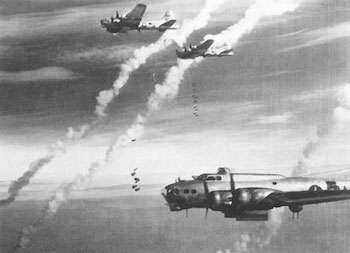 The U.S. Eighth Air Force launches a major daylight bombing raid against Berlin. The primary target is a critical ball bearing plant at Erkner, located on the outskirts of the German capital.
German air defenses respond fiercely. Heavy anti-aircraft fire and large numbers of German fighter aircraft intercept the bomber formations.
Despite the intense opposition, American bombers press their attack. However, the mission proves costly. Thirty-seven bombers and sixteen escorting fighters are lost during the operation, illustrating the dangerous nature of strategic bombing over heavily defended Germany.
1945 – Allied Forces Advance into Western Germany
British and Canadian forces participating in Operation Blockbuster enter the city of Xanten on the Rhine River after several days of heavy fighting. The operation is part of the broader Allied offensive to clear German forces west of the Rhine and prepare for the final invasion of Germany.
Further south, American troops advance into the historic city of Bonn, continuing the rapid Allied push across western Germany as the Third Reich begins to collapse.
1945 – Secret Negotiations Begin in Switzerland
In Bern, Switzerland, secret negotiations begin between representatives of the American Office of Strategic Services (OSS) and German commanders in Italy. The discussions involve OSS officer Allan Dulles and senior German officers including General Heinrich von Vietinghoff and SS General Karl Wolff.
The purpose of these talks is to arrange an early surrender of German forces in Italy in order to shorten the war and reduce casualties. These negotiations eventually lead to the German surrender in northern Italy in April 1945.
1945 – Red Army Pushes Into Breslau
On the Eastern Front, Soviet forces continue their advance into Germany. The Red Army penetrates the southern suburbs of the heavily fortified city of Breslau (modern-day Wrocław, Poland).
The city has been declared a “fortress” by Adolf Hitler and German forces are ordered to defend it to the last. The siege of Breslau will continue for several more months before the city finally surrenders shortly before the end of the war.