
1940 — Total War Measures in Germany
As Germany continues to mobilize its economy for total war, the government orders civilian car owners to surrender batteries for military use. At the same time, church bells across Germany are confiscated and melted down to provide metal for armaments production.
These measures reflect the increasing demands placed on German society as the war effort expands and industrial resources become critical to sustaining military operations.
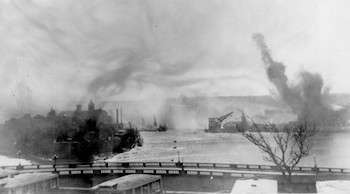 1941 — Luftwaffe Assault on Malta
The Luftwaffe launches a heavy and sustained bombing campaign against the island of Malta, one of the most strategically important Allied positions in the Mediterranean.
The intensity of the attacks forces the Royal Air Force to withdraw many of its bombers and flying boats from the island, reducing Malta’s ability to strike Axis supply lines to North Africa. The island remains under constant threat as Axis forces attempt to neutralize it.
1942 — War Expands Across the Globe
Japanese-American Internment Begins
The United States government begins relocating Japanese Americans from their homes along the West Coast to detention centers. The action follows Executive Order 9066 and marks one of the most controversial domestic policies of the war.
Malta Convoy Reaches Valletta
A British convoy managing to avoid major naval engagement approaches Malta, but comes under heavy Axis air attack as it nears the island.
One freighter is sunk and another damaged, but two ships successfully reach the port of Valletta. Continued air raids against the docks make unloading supplies extremely difficult, limiting the immediate effectiveness of the convoy’s success.
Japanese Advance in the Indian Ocean
Japanese forces occupy the Andaman Islands, extending their control across the Indian Ocean and threatening Allied supply routes between India and Southeast Asia.
Air Attacks on Port Moresby
Japanese aircraft launch additional attacks against Port Moresby in New Guinea, continuing efforts to neutralize the key Allied base.
1943 — Air War and Ground Fighting Intensify
RAF Bombing of Dortmund
In one of the heaviest raids to date, the Royal Air Force drops approximately 2,000 tons of bombs on the German industrial city of Dortmund, causing extensive damage.
Battle of El Guettar
During the Battle of El Guettar in Tunisia, U.S. infantry forces successfully repel German armored attacks. The victory marks an important moment for American ground forces gaining experience against seasoned Axis troops.
1944 — Resistance in Occupied Europe
In Rome, Italian partisans carry out a bombing attack against a German SS police unit, killing 33 German personnel. The attack also results in the deaths of 10 Italian civilians and leads to harsh German reprisals.
1945 — Allied Forces Cross the Rhine
RAF Raid on Hildesheim
The RAF launches a devastating raid involving approximately 300 bombers against the German city of Hildesheim. Although not a major industrial center, the attack causes widespread destruction across the city.
British Cross the Rhine at Wesel
Field Marshal Bernard Montgomery’s British Second Army crosses the Rhine River at Wesel, marking a critical phase in the Allied invasion of western Germany.
Patton Crosses North of Worms
The U.S. Third Army crosses the Rhine north of Worms, continuing the rapid Allied advance into Germany. At the same time, British and Canadian forces begin their own crossings north of the Ruhr, tightening the encirclement of German forces.
Soviets Advance on the Baltic
The Red Army reaches the outskirts of Danzig and Gotenhafen, key ports on the Baltic Sea, as German forces continue to retreat.
de Gaulle Moves Toward Self-Government in Indochina
French leader Charles de Gaulle announces limited self-government for French Indochina, signaling the beginning of political changes that will reshape the region after the war.
 Benjamin O. Davis and the Tuskegee Airmen
 Benjamin O. Davis and the Tuskegee Airmen
Colonel Benjamin O. Davis Jr. prepares to fly escort missions over Berlin with the 332nd Fighter Group, part of the famed Tuskegee Airmen. Davis will later become the first African American general officer in the U.S. Air Force, marking a historic milestone in military leadership.