
1940 — Political Change in France and Early Naval War
Paul Reynaud becomes Prime Minister of France, replacing Édouard Daladier, who assumes the role of Minister of Defense and War. Reynaud advocates for a more aggressive stance against Nazi Germany as the conflict in Europe continues to escalate.
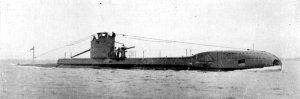 At sea, the British submarine HMS Ursula sinks the German freighter Heddernheim, marking the first German merchant ship sunk by a British submarine during the war. The engagement highlights the growing importance of submarine warfare in disrupting enemy supply lines.
1941 — British Advance in North Africa
The last Italian stronghold in eastern Libya falls to advancing British forces. This success marks the near-complete collapse of Italian resistance in Cyrenaica and demonstrates the effectiveness of Allied operations in North Africa during this phase of the campaign.
1942 — Malta Under Threat and U.S. Policy at Home
Spitfires Reinforce Malta
In a continuation of earlier operations, 16 additional Supermarine Spitfires are delivered to the island of Malta by British carrier forces. Malta remains a critical Allied base in the Mediterranean, under constant threat from Axis air and naval attacks.
Italian Fleet Sorties Against Allied Convoy
With intelligence of a large British convoy heading toward Malta, the Italian Navy responds decisively. Admiral Angelo Iachino departs Taranto with the battleship Littorio and destroyers, while Admiral Parona sails from Messina with cruisers and additional escorts.
These movements set the stage for further naval clashes in the Mediterranean as both sides fight for control of supply routes to Malta.
Executive Order 9066 Enforced
President Franklin D. Roosevelt signs legislation making violations of Executive Order 9066 a federal offense. The order authorizes the forced relocation and internment of Japanese Americans from the West Coast, one of the most controversial domestic actions taken during the war.
1943 — War on Multiple Fronts
Hitler Breaks His Silence
After four months without a public address, Adolf Hitler delivers a speech on Heroes’ Day, attempting to rally German morale as the war situation becomes increasingly difficult for the Axis powers.
Another Assassination Attempt
A failed assassination attempt is made against Hitler during the Heroes’ Day events. Despite multiple plots throughout the war, all attempts to remove him from power ultimately fail until the final days of the conflict.
Rangers Strike in Tunisia
In North Africa, U.S. Army Rangers ambush Italian forces near Gafsa, capturing approximately 1,000 prisoners of war in a successful engagement.
 Loss of a Pioneer Aviator
 Loss of a Pioneer Aviator
Cornelia Fort, a pioneering female aviator and member of the Women’s Auxiliary Ferrying Squadron (WAFS), is killed in a mid-air collision while ferrying a training aircraft in Texas. She becomes one of the first American women pilots to die in service during the war.
1944 — Natural Disaster in Wartime Italy
The eruption of Mount Vesuvius devastates parts of southern Italy, burying the villages of San Sebastiano and Massa. Massive lava fountains reaching heights of up to 6 kilometers are observed, adding to the destruction already caused by ongoing military operations in the region.
1945 — Allied Advances and Tragedy
 U.S. First Army Advances from Remagen
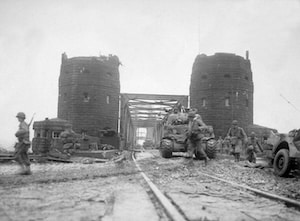 U.S. First Army Advances from Remagen
American forces continue expanding their positions from the Remagen bridgehead, advancing toward the German city of Siegburg as the Allies push deeper into western Germany.
Soviets Capture Stuhlweissenburg
The Red Army captures the Hungarian city of Székesfehérvár (Stuhlweissenburg), further weakening German defenses in Central Europe.
Massive Bombing of Hamburg
The U.S. Eighth Air Force launches a large-scale bombing raid on Hamburg, sending approximately 650 bombers against the important industrial and port city.
Tragedy in Copenhagen
During an Allied bombing operation targeting the Gestapo headquarters in Copenhagen, several bombs mistakenly strike a nearby school. The tragic error results in the deaths of 86 children and 17 teachers, one of the most heartbreaking incidents of the war.
First Use of Ohka Kamikaze Aircraft
Japanese forces deploy the rocket-powered Ohka kamikaze aircraft for the first time. Although the weapon is designed for high-speed suicide attacks against Allied ships, its initial use causes limited damage and highlights the desperation of Japan’s late-war tactics.