
1940 — Hitler and Mussolini Meet at the Brenner Pass
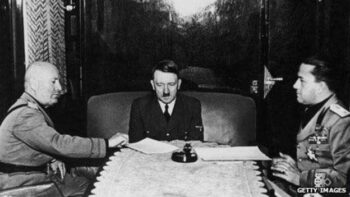 Adolf Hitler and Italian dictator Benito Mussolini meet at the Brenner Pass in northern Italy. During the meeting Mussolini agrees that Italy will enter the war on Germany’s side “at an opportune moment.”
At the time Italy remained officially neutral, but the discussion confirmed Mussolini’s growing commitment to the Axis alliance. Within three months Italy would declare war on Britain and France.
The Bombe Begins Breaking Enigma
At Bletchley Park in England, the first operational version of Alan Turing’s “Bombe” electromechanical machine becomes operational. The machine is designed to help decrypt messages produced by the German Enigma cipher system.
The Bombe dramatically accelerates the codebreaking process and becomes one of the most important intelligence tools of the war, allowing Allied analysts to read large portions of German military communications.
Soviet Assurances to Sweden
Following Finland’s surrender in the Winter War, the Soviet Union assures Sweden that its neutrality and territorial integrity will be respected. The statement is intended to calm fears in Scandinavia about further Soviet expansion.
1941 — War Expands in the Atlantic and Europe
United States and Canada Sign Defense Pact
The United States and Canada sign a joint defense agreement, strengthening military cooperation between the two countries as the war continues to escalate in Europe.
German Spy Dies in New York
German intelligence officer Captain Ulrich von der Osten is struck and killed by a car in New York City. After the accident, fellow German spy Kurt Ludwig steals von der Osten’s briefcase containing espionage materials.
The incident eventually triggers an FBI investigation into German spy networks operating inside the United States.
Luftwaffe Bombs Liverpool
The Luftwaffe launches bombing raids against Liverpool and nearby Birkenhead, two vital British ports responsible for handling large volumes of Atlantic shipping and wartime supplies.
Rommel Travels to Germany
German commander Erwin Rommel departs North Africa to meet with Adolf Hitler in Germany to discuss operations of the newly arrived Afrika Korps.
British Vessel Sunk by Mine
The British armed boarding vessel Rosaura strikes a naval mine off the coast of Tobruk and sinks, illustrating the continuing danger posed by naval mines throughout the Mediterranean.
1942 — Allied Command and Domestic Policies
Mountbatten Takes Command
Lord Louis Mountbatten is appointed Chief of Combined Operations, placing him in charge of planning amphibious raids and special operations against Axis positions.
Allied Forces Secure the New Hebrides
American forces occupy the New Hebrides islands in the South Pacific in order to strengthen defenses and protect Australia from possible Japanese attack.
War Relocation Authority Created
President Franklin D. Roosevelt establishes the War Relocation Authority under Milton Eisenhower. The agency oversees the controversial relocation and internment of Japanese-Americans living along the U.S. West Coast.
1943 — Allied Advances in Africa and Asia
Chindits Cross the Irrawaddy
British long-range penetration forces known as the Chindits cross the Irrawaddy River in Burma, operating deep behind Japanese lines to disrupt supply routes and communications.
U.S. II Corps Captures El Guettar
American forces of the U.S. II Corps capture El Guettar in Tunisia, continuing the Allied push to eliminate Axis forces from North Africa.
Daylight Bombing Gains Support
After a successful U.S. Eighth Air Force mission against the German shipbuilding center at Vegesack, American commanders declare that their strategy of precision daylight bombing has proven effective.
1944 — War Reaches Hungary
Tank Attack at Monte Cassino Fails
A New Zealand armored assault against German defenses at Monte Cassino is repulsed. All 17 attacking tanks are lost, demonstrating the extreme difficulty Allied forces faced in breaking the German defensive line in Italy.
Germany Occupies Hungary
Hitler forces Hungarian regent Admiral Miklós Horthy to accept a new alliance agreement that includes the occupation of Hungary by German troops.
The agreement also opens the door for the deportation of Hungary’s Jewish population, numbering roughly 750,000 people, many of whom would later be sent to Nazi concentration and extermination camps.
1945 — Final Battles in Europe and the Pacific
Kolberg Falls
The Baltic port city of Kolberg falls to the Polish 1st Army, operating under the Soviet 2nd Belorussian Front. Before the city collapses, German forces manage to evacuate approximately 80,000 civilians and wounded soldiers by sea.
Third Army Captures Boppard
The U.S. Third Army captures the Rhine River town of Boppard as Allied forces continue their advance into western Germany.
U.S. Fifth Fleet Strikes Japan
The U.S. Fifth Fleet launches heavy air attacks against the Japanese home islands of Kyushu, Shikoku, and Honshu. The strikes are part of preparations for the upcoming Allied invasion of Okinawa.