
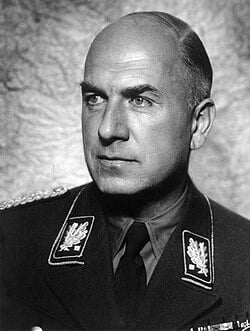
 1940 — Fritz Todt Named Armaments Minister
Fritz Todt, a prominent engineer and Nazi official, is appointed German Minister for Armaments and Munitions. Todt had previously overseen massive construction projects for the Nazi regime, including the Autobahn highway system and major military fortifications such as the Atlantic Wall.
His new role places him in charge of coordinating Germany’s rapidly expanding war production, making him one of the most powerful figures in the Nazi war economy.
1941 — Allied Advances in East Africa
Capture of Jijiga
The British-led 11th African Division captures the town of Jijiga in central Abyssinia (modern Ethiopia). The advance is remarkable for its speed — Allied forces had traveled nearly 744 miles in just seventeen days along the Italian-built Strada Imperiale, a major military road constructed during Italy’s occupation of Ethiopia.
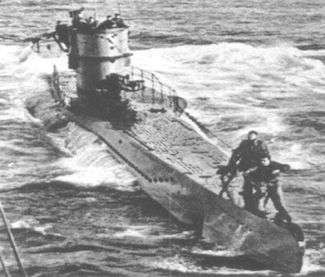 Battle of the Atlantic – U-99 Lost
During attacks on convoy HX-112, the British destroyer HMS Walker forces the German submarine U-99 to scuttle. Forty of the forty-three crew members survive and are captured, including the highly successful U-boat commander Otto Kretschmer.
Kretschmer had been one of Germany’s most effective submarine captains, credited with sinking dozens of Allied ships during the early stages of the Battle of the Atlantic.
Wartime Rationing in Britain
In Britain, food rationing expands to include jam and marmalade, limited to approximately eight ounces per person per month. The measure reflects the strain placed on Britain’s food supply by German U-boat attacks on Atlantic shipping.
Luftwaffe Raid on Bristol
German aircraft launch a major bombing raid against the Avonmouth district of Bristol. A total of 162 Luftwaffe bombers participate in the attack, targeting port facilities and industrial sites along the River Avon.
1942 — War Intensifies Across the Globe
MacArthur Reaches Australia
General Douglas MacArthur is flown by a B-17 bomber from Mindanao to Australia after escaping the Philippines under orders from President Roosevelt. His arrival marks the beginning of his leadership of Allied operations in the Southwest Pacific.
Deportations Begin to Belzec
Nazi authorities begin deporting Jews from the city of Lublin to the newly established extermination facility at Belzec. These deportations mark the beginning of systematic mass killings at the camp.
The first mass gassings at Belzec occur on this date, representing a major step in the implementation of the Nazi regime’s “Final Solution.”
Britain Expands Wartime Rationing
Facing growing energy shortages, the British government introduces rationing of both fuel and electricity, ensuring that critical wartime industries receive priority access to limited resources.
1943 — Resistance and Offensives
Bulgaria Refuses Nazi Deportation Demand
The government of Bulgaria, despite being allied with Germany, refuses to comply with a German demand that Bulgarian Jews be deported to Nazi concentration camps. The Bulgarian Parliament unanimously votes to cancel the deportation plan proposed by government official Alexander Belev.
As a result, the Jewish population living within Bulgaria itself avoids deportation, though tragically Jews from occupied territories in Macedonia and Thrace are still sent to Nazi camps.
Japanese Offensive in Burma
Japanese forces attack British positions in the Arakan region of western Burma. The offensive forces Indian troops to withdraw as the Japanese attempt to expand their control in the region.
Patton Advances in Tunisia
Lieutenant General George S. Patton launches an offensive from Fériana in Tunisia and successfully captures the town of Gafsa, continuing the Allied push against Axis forces in North Africa.
1944 — Fighting Continues in Burma and Italy
Bridge Destroyed Near Imphal
British forces destroy the Manipur bridge south of Imphal in order to slow advancing Japanese troops during the growing crisis along the India–Burma frontier.
Battle of Monte Cassino
New Zealand troops capture the Cassino railway station, a key objective in the ongoing battle for control of the Italian town of Monte Cassino. Despite the success, the battle remains one of the most grueling campaigns of the Italian front.
1945 — Final Battles in Germany
U.S. Third Army Captures Koblenz
The U.S. Third Army captures the important German city of Koblenz, located at the strategic junction of the Rhine and Moselle rivers.
 Collapse of the Remagen Bridge
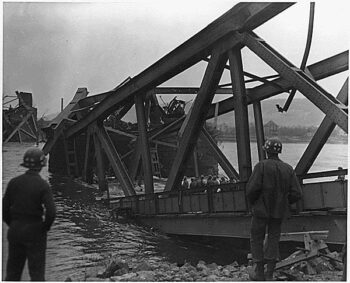 Collapse of the Remagen Bridge
The Ludendorff Bridge at Remagen, famously captured intact by U.S. forces on March 7, suddenly collapses while American engineers are reinforcing it. Dozens of U.S. Army engineers are killed in the disaster.
Despite the loss of the bridge, American engineers quickly construct a replacement pontoon bridge in just ten hours, ensuring that Allied forces can continue crossing the Rhine and advancing deeper into Germany.