
1935 — Hitler Orders German Rearmament
Adolf Hitler announces the formal rearmament of Germany, openly violating the restrictions imposed by the Treaty of Versailles. The announcement includes the expansion of the German army and the creation of a new air force, the Luftwaffe.
The move represents a decisive step in dismantling the post-World War I international order. Although the treaty had strictly limited German military forces, the Nazi regime openly rejects these constraints and begins rebuilding Germany into a powerful military state.
1939 — Germany Occupies the Rest of Czechoslovakia
German forces occupy the remaining territories of Czechoslovakia, completing the dismantling of the country. The regions of Bohemia and Moravia are placed under direct German control as a protectorate, while Slovakia becomes a nominally independent but German-aligned state.
The occupation marks a clear demonstration that Adolf Hitler’s territorial ambitions extend far beyond the promises made during earlier diplomatic negotiations.
1940 — Luftwaffe Raid on Scapa Flow
The Luftwaffe launches an air attack against the British fleet anchorage at Scapa Flow in the Orkney Islands, one of the Royal Navy’s most important bases.
The raid results in the death of a British civilian, marking the first civilian casualty of the war in Britain. Although the attack causes limited damage to naval facilities, it signals that even the most secure British naval bases are vulnerable to German air power.
1941 — U-Boat Aces Captured
The German Navy suffers a major loss when two of its most successful submarine commanders are captured during operations against Allied convoy HX-112.
Otto Kretschmer, commander of U-99, and Joachim Schepke, commander of U-100, are intercepted by British escort ships. Schepke is killed when his submarine is rammed and sunk, while Kretschmer is forced to surface and is taken prisoner.
The loss of these experienced commanders is a significant blow to the German U-boat arm during the early stages of the Battle of the Atlantic.
British Capture Berbera
British troops operating from Aden land at and capture the port of Berbera in Italian-occupied British Somaliland. The operation helps restore Allied control in the region following earlier Italian advances in East Africa.
1943 — Intense Fighting in the Atlantic
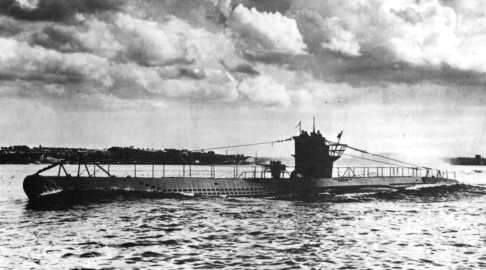 German submarine wolfpacks launch coordinated attacks on Allied convoys crossing the North Atlantic.
The wolfpack Raubgraf attacks convoy HX-229, consisting of 37 merchant ships, sinking 12 ships totaling 86,326 tons and damaging four others.
At the same time, another wolfpack known as Stürmer attacks convoy SC-122. Over four days and nights of fighting, German submarines sink 11 Allied ships totaling more than 54,000 tons. Only one German submarine, U-384, is lost during the engagement.
These battles represent some of the most intense convoy battles of the entire Battle of the Atlantic.
1944 — Fighting in Burma and Italy
Chindit Operations in Burma
The British long-range penetration force known as the Chindits establishes a fortified jungle base called “White City” near Mawlu in northern Burma. The base successfully cuts Japanese communications and supply routes, disrupting enemy operations in the region.
 Spy Executed in Britain
 Spy Executed in Britain
Oswald Job, a British citizen convicted of spying for Germany, is executed at Pentonville Prison in London.
Battle of Monte Cassino Continues
The British Eighth Army continues its costly attempts to break through German defenses at Monte Cassino in Italy. The heavily fortified German positions and difficult mountainous terrain make progress slow and costly.
Japanese Advance Toward Imphal
Japanese forces advancing through Burma isolate the British garrison at Imphal. During the siege that follows, approximately 150,000 Allied troops depend entirely on air supply for survival.
More than 400 tons of supplies must be flown into the valley each day, while a small force of RAF fighters — including Spitfires and Hurricanes — attempts to defend the air supply corridor against Japanese attacks.
1945 — Final Battles of the War
Iwo Jima Declared Secure
U.S. military commanders declare the island of Iwo Jima secured after weeks of brutal fighting. Although small pockets of Japanese resistance remain hidden in caves and tunnels, organized defense of the island has effectively ended.
Soviet Counterattack Near Budapest
Two fresh Soviet armies belonging to the 3rd Ukrainian Front launch a counterattack against German forces attempting to relieve pressure near Budapest. The operation halts the German offensive and further weakens Axis positions in Hungary.
Bombing of German High Command Headquarters
The U.S. Eighth Air Force launches a massive bombing raid involving 675 bombers against the headquarters complex of the German Army High Command (OKH) at Zossen, located about twenty miles south of Berlin. Despite the scale of the attack, the raid causes only limited damage to the underground command facilities.
German Cruisers Support Kurland Defense
The German heavy cruisers Schlesien and Prinz Eugen provide naval artillery support for German ground forces defending the Kurland Pocket in Latvia, where large Axis forces remain trapped by advancing Soviet armies.