1939 – Finnish Success in the Winter War
Finnish forces overrun Soviet units at Ägläjärvi in eastern Finland,continuing their stubborn resistance during the Winter War and inflicting heavy losses on Red Army formations operating in extreme cold and forest terrain.
1940 – Political Change and the Blitz Intensifies
In Britain, David Margesson is appointed Secretary of State for War, replacing Anthony Eden.
In the Balkans, the Battle of Himara concludes with a Greek victory, further embarrassing Italian forces in Albania.
Meanwhile, the heaviest raids of the Manchester Blitz begin.
Over the next two days, German bombing kills 654 civilians and injures more than 2,000, leaving widespread destruction across the city.
1941 – Strategy Decided as the War Goes Global
 Prime Minister Winston Churchill arrives at the White House as the guest of President Franklin D. Roosevelt, marking the start of a critical series of wartime meetings.
The Arcadia Conference opens in Washington. British and American leaders agree on a “Germany First” strategy, prioritizing the defeat of Nazi Germany before turning full attention to Japan.
In the Pacific, Japanese forces launch the main invasion of the Philippines.
Approximately 43,000 troops of General Masaharu Homma’s 14th Army land in Lingayen Gulf, about 150 miles north of Manila. Filipino defenders fail to prevent the establishment of a beachhead, and reconnaissance units sent to block the southern approaches are unable to halt the advance.
The first American troops arrive in Australia, signaling the beginning of a major Allied buildup in the Southwest Pacific.
In the United States, the draft is expanded: all men aged 18 to 65 are required to register, while men aged 20 to 44 become eligible for conscription.
In North Africa, Allied forces reach Beda Fomm but are halted by a blocking force of just 30 German tanks. Axis troops begin evacuating Benghazi by sea.
In the Balkans, the Battle of Sjenica is fought in the Italian governorate of Montenegro, ending in defeat for the Yugoslav Partisans.
German submarine U-380 is commissioned.
1942 – Convoys and Soviet Advances
Arctic convoy JW-51B, consisting of 14 merchant ships escorted by six destroyers and a minesweeper, departs Loch Ewe bound for the Soviet Union.
On the Eastern Front, Soviet forces drive German troops back 15 miles along the Don River and retake the key rail town of Morozovsk.
German submarine U-200 is commissioned.
In Australia, Ben Chifley is appointed Minister of Post-War Reconstruction, beginning early planning for life after the conflict.
1943 – Partisans, Propaganda, and Collapse
The Allies announce that Josip Broz Tito is recognized as the Allied commander in Yugoslavia. His Partisan forces are now estimated at 250,000 fighters.
Adolf Hitler issues a Führer Order creating the National Socialist Leading Officers, tasked with spreading propaganda and reinforcing belief in “final victory,” even as Germany’s situation worsens.
The German government orders that all boys aged 16 and older must register for military service beginning in January.
The Second Battle of Kiev ends in a decisive Soviet victory.
In the Adriatic, the German light cruiser Niobe is sunk by British motor torpedo boats three days after running aground near Silba, Yugoslavia.
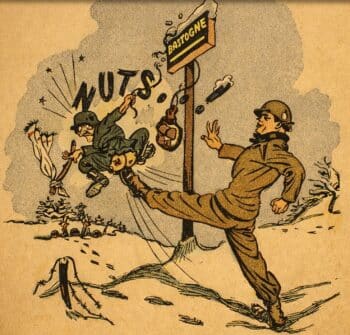
1944 – “NUTS!” at Bastogne
 Allied reports confirm that German forces have penetrated up to 40 miles into the Ardennes during the Battle of the Bulge.
German commanders demand the surrender of surrounded Bastogne.
The acting commander of the 101st Airborne Division,
Brigadier General Anthony McAuliffe, replies with a single word: “NUTS!”
Field Marshal Gerd von Rundstedt’s recommendation to withdraw is rejectedby Hitler.
The U.S. Third Army launches an offensive to relieve Bastogne.
As promised days earlier, General George S. Patton pivots his army nearly 90 degrees north, moving some 250,000 troops over 75 miles in freezing conditions.
The 101st Airborne Division remains surrounded at Bastogne, while the U.S. First Army withdraws from St. Vith.
In Britain, the government announces the call-up of 250,000 additional troops to sustain frontline forces.
1945 – Recognition and Resettlement
Britain and the United States formally recognize Tito’s Yugoslavia as the legitimate government.
President Harry S. Truman issues the Truman Directive, authorizing increased immigration for displaced persons uprooted by the war.
1948 – Justice After the War
Former Japanese Prime Minister Hideki Tojo is executed for war crimes.
Having failed in an earlier suicide attempt, Tojo faces execution followingconviction for his role in Japan’s wartime leadership.