
1938 – Diplomatic Tensions Between Italy and France
Italy declares the 1935 pact with France invalid, arguing that ratifications had never been formally exchanged.
The French government firmly rejects the claim, further straining already tense relations in pre-war Europe.
1939 – The Scuttling of the Admiral Graf Spee
Unable to complete repairs within the 24-hour limit imposed by international law on foreign warships in neutral ports,
and under strict orders from the German Naval Command not to accept internment in Uruguay,
Captain Hans Langsdorff takes the pocket battleship Admiral Graf Spee out of Montevideo harbor.
Before a British fleet converging on the River Plate can engage her, Langsdorff orders the ship scuttled,
denying the Royal Navy a final victory in what would have been a hopeless battle.
The dramatic end of the Graf Spee marks one of the most famous naval episodes of the early war.
Meanwhile, on the northern front, Soviet forces launch heavy attacks against Finnish positions at Summa during the Winter War.
1940 – War at Sea and at Home
In Britain, the Home Office announces the execution of a third German spy at Pentonville Prison.
A Winchester housewife is also sentenced to death for espionage, highlighting the seriousness with which Britain confronts internal threats.
As a morale boost, ration allowances are temporarily increased for the Christmas week.
In the air war, fifty Bomber Command Whitley and Hampden aircraft strike German seaplane bases on the island of Sylt in the Frisian Islands.
In North Africa, British forces pursuing retreating Italian troops capture Sollum, Fort Capuzzo, and several key defensive positions, taking an additional 38,000 Italian prisoners.
At sea, the destroyer HMS Acheron is sunk after striking a mine off the Isle of Wight.
1941 – Axis Advances and Setbacks
After meeting strong resistance, Rommel’s Afrika Korps retreats from the Gazala defensive area in Libya.
In Southeast Asia, Japanese troops advance rapidly through northern Malaya and reach within ten miles of Penang.
British and Commonwealth forces fall back toward the Perak River.
Japanese forces also conduct landings in northern Borneo, widening their offensive across the region.
1942 – The World Responds to Nazi Crimes
In a powerful statement to Parliament, British Foreign Secretary Anthony Eden declares that Germany is carrying out
Hitler’s repeatedly stated intention to exterminate the Jewish people of Europe.
Britain vows that these crimes will be avenged, a pledge echoed by the United States.
In the Pacific, the final combined U.S.–Australian assault on Buna begins, marking the climax of brutal jungle fighting in New Guinea.
1943 – Progress on Multiple Fronts
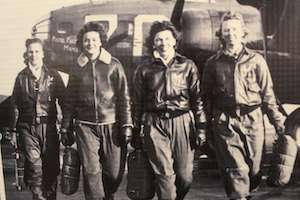 The first pilot wings are awarded to members of the WASPs (Women Airforce Service Pilots),
a historic recognition of their vital contribution to the U.S. war effort.
In Italy, the U.S. Fifth Army captures the village of San Pietro after ten days of intense fighting.
President Franklin D. Roosevelt reveals that a plot to assassinate him was uncovered during the Tehran Conference.
Elsewhere in the Pacific, U.S. forces invade Japanese-held New Britain Island in New Guinea.
1944 – Turning Points and Tragedy
The United States formally approves the end of the internment of Japanese Americans.
Major General Henry C. Pratt issues Public Proclamation No. 21, declaring that Japanese American evacuees
may begin returning to their homes on January 2, 1945.
 In Europe, German forces launch deep penetrations into unprepared American lines during the opening phase of the
Battle of the Bulge. Progress is slowed by limited roads, rugged terrain, and harsh winter weather
as Allied reinforcements rush toward the Ardennes.
The German Army renews attacks near Losheimergraben against American defenders.
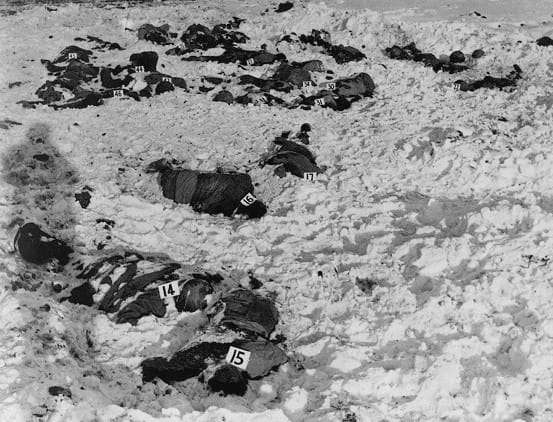
On this day, 81 American soldiers from Battery B, 285th Field Artillery Observation Battalion,
are murdered by Waffen-SS troops near Malmedy—a massacre that will come to symbolize the brutality of the Ardennes campaign.