A day marked by puppet regimes, submarine attacks, urgent warnings, new fronts in the air, and the tightening Allied grip on Axis strongholds.
1939 – The Soviets Install a Puppet Regime & Finland Fights Back
As the Winter War entered its second day, the Soviet Union made a bold political move: Moscow announced the creation of a
“Finnish Democratic Republic” under communist leader Otto Kuusinen. Installed as a puppet government, Kuusinen immediately
agreed to Soviet territorial demands—territory Finland itself was still fiercely defending.
On the coast, Finnish resistance proved anything but symbolic. At Russar Island, coastal guns engaged the Soviet cruiser
Kirov and its escorting destroyers. Finnish fire struck home, damaging the Kirov and one destroyer and demonstrating that
Finland would contest both land and sea with determination.
1940 – Submarine Attack & First Strike by the LRDG
RCN Destroyer Saguenay Torpedoed
In the cold waters west of Ireland, the Italian submarine Argo torpedoed the Canadian destroyer HMCS Saguenay,
killing 21 sailors. Although badly damaged, the destroyer refused to sink and managed to remain afloat—a testament to her crew and construction.
At the time, Saguenay had been escorting an eastbound convoy across the U-boat-infested North Atlantic.
 LRDG Conducts Its First Attack
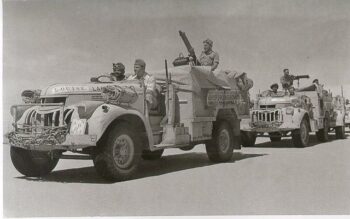 LRDG Conducts Its First Attack
In North Africa, the British Long Range Desert Group (LRDG)—a pioneering deep-reconnaissance and raiding force—launched its
first operational attack. Operating from Egypt, the LRDG specialized in navigating the vast Libyan desert to strike Axis positions
far behind enemy lines. Their tactics would later influence modern special operations doctrine.
Joseph Kennedy Resigns
Across the Atlantic, U.S. Ambassador to Britain Joseph P. Kennedy resigned from his post.
Kennedy, deeply pessimistic about Britain’s chances and strongly opposed to U.S. intervention in the war, clashed repeatedly with the Roosevelt administration.
His departure removed one of the most prominent voices arguing against aiding the Allies.
1941 – Countdown to Pearl Harbor
Emergency Declared in Malaya & Hong Kong
With tensions rising across Asia, British authorities declared a State of Emergency in Malaya, while Hong Kong was placed on
full standby. The region braced for what many feared was coming.
Japan Sets December 7 as the Date of Attack
In Tokyo, the Japanese government fixed the date of its strike on Pearl Harbor:
December 7, 1941.
Though some factions remained hesitant, the path to war had been chosen.
American Responses and Growing Blind Spots
In Washington, U.S.–Japanese diplomatic talks continued, but President Roosevelt curtailed his holiday plans, fully aware of the
dangerous moment ahead. The U.S. also established the Civil Air Patrol to integrate civilian pilots into coastal defense.
Meanwhile, the Japanese Navy changed its communications code—severing key American intelligence insight into Japanese fleet
movements. The United States, unknowingly, went blind just as the decisive blow approached.
1942 – Rationing, Victories, and Naval Battles
Coffee Rationing Begins in the U.S.
On the American home front, coffee officially joined the list of rationed goods to ensure sufficient supplies for troops overseas.
Households nationwide adjusted their routines as ration books became a fixture in everyday life.
Australians Capture Gona
In New Guinea, Australian troops successfully captured Gona, one of the Japanese beachheads on the northern coast.
This victory marked a major step in the grueling Papuan Campaign, opening the way toward Buna and Sanananda.
The Battle of Tassafaronga
Off Guadalcanal, the Battle of Tassafaronga saw U.S. warships intercept a Japanese resupply run.
The Americans repulsed the enemy but suffered heavy damage when Japanese torpedoes struck with deadly precision.
The engagement highlighted Japan’s mastery of night fighting—and the high cost of the struggle for Guadalcanal.
1943 – Breakthroughs in Italy and the East
The Garigliano Offensive Begins
The British 10th Corps opened the Fifth Army’s assault on the Garigliano River, pressing German defenses in southern Italy.
The offensive marked another push in the long battle up the Italian peninsula.
Soviets Tighten Their Grip on the Crimea
On the Eastern Front, the Red Army isolated German forces in the Crimea and seized control of the northern half of the
Dnieper bend. Soviet momentum continued to build as the Wehrmacht reeled from constant retreat.
The Tehran Conference Concludes
In Iran, the Tehran Conference concluded. Roosevelt, Churchill, and Stalin reached substantial agreement on post-war
boundaries—particularly the division of Germany, the westward shift of Poland’s frontiers, and even discussions about the execution
of tens of thousands of German officers.
Although the more extreme proposals were never adopted, the decisions made at Tehran shaped the post-war world map.
 The Mustang Arrives in Europe
 The Mustang Arrives in Europe
The U.S. made its first operational use of the P-51 Mustang fighter in Europe, as the Ninth Air Force flew a sweep over France.
The Mustang would soon become the Allies’ premier long-range escort fighter—one of the most effective aircraft of the war.
Mussolini Orders Arrest of Jews
In Italy, Mussolini ordered the arrest of all Jews still within his remaining territory.
But many Italians—civilians, clergy, and officials—risked their lives to hide and protect Jewish neighbors from persecution.
1944 – Naval Launches and Shifting Campaigns
Princess Elizabeth Launches HMS Vanguard
In Scotland, Princess Elizabeth christened HMS Vanguard, the last and largest battleship ever built for the Royal Navy.
Though the era of battleships was ending, Vanguard was a symbol of British naval engineering at its peak.
German Withdrawal from Crete
On Crete, German forces completed the evacuation of most of their positions as Allied pressure increased across the Mediterranean.
The island, conquered by paratroopers in 1941, was slipping from Axis control.
1945 – The Last Reckonings
In Allied-occupied Germany, 76 industrialists who had supported and financed the Nazi war machine were arrested.
The move was part of the broader dismantling of militaristic structures that had fueled Hitler’s rise.
Remembering December 2
From puppet governments and coastal batteries to diplomatic resignations, rationing, and the first flights of legendary aircraft,
December 2 reveals how the war touched every corner of the globe.
The decisions and battles of this day—some dramatic, others quietly consequential—shaped the path toward victory and the world that followed.
Lest we forget.