
1937 – The Panay Incident on the Yangtze
Japanese aircraft and artillery fire on foreign vessels along the Yangtze River in China, sinking the American gunboat USS Panay.
Japan issues a formal apology to the United States and agrees to pay reparations.
While Washington accepts the apology, Britain refuses to do so, further straining relations as war in Asia deepens.
1939 – Fighting in Finland and the North Sea
Finnish forces achieve notable success against Soviet troops at Tolvajärvi, inflicting heavy casualties during the Winter War and boosting Finnish morale.
At sea, two German cruisers escorted by five destroyers are damaged by torpedoes from the British submarine HMS Salmon as they return from a mine-laying mission off England’s northeast coast.
Later the same day, HMS Salmon encounters a German passenger liner and issues a warning in accordance with the rules of war. The liner is allowed to proceed and reaches Bremen safely.
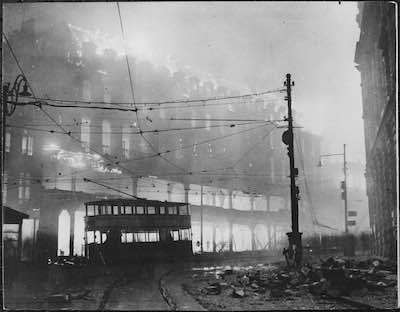 1940 – The Blitz Strikes Sheffield
The city of Sheffield is heavily bombed by the Luftwaffe during the Blitz, causing widespread destruction to homes and industry.
In Washington, Philip Kerr, Lord Lothian, Britain’s ambassador to the United States, dies suddenly while serving in a critical diplomatic role.
1941 – War Widens in Europe
The Tragedy of the Struma
The ship Struma departs Romania carrying 769 Jewish refugees bound for Palestine.
British authorities later refuse permission for the passengers to disembark.
In February 1942, the vessel is forced back into the Black Sea, where it is intercepted and sunk by a Soviet submarine, mistakenly identified as an enemy target.
Nearly all aboard perish.
Declarations of War
Britain declares war on Bulgaria.
Bulgaria responds by declaring war on both Britain and the United States.
Hungary and Romania also declare war on the United States.
In response, the United States formally declares war on Hungary, Romania, and Bulgaria, further expanding the global conflict.
1942 – Manstein’s Counterattack and Naval Losses
Field Marshal Erich von Manstein launches a desperate counterattack to relieve the encircled German Sixth Army at Stalingrad.
His hastily assembled force includes 13 divisions, among them three Panzer divisions fielding roughly 230 tanks.
At sea, the British destroyer HMS Partridge is sunk off the coast of Algeria by German submarine U-565, commanded by Wilhelm Franken.
1943 – Command Changes and Diplomacy
Field Marshal Erwin Rommel is appointed Commander-in-Chief of Army Group B, responsible for defending the Atlantic coastline from the Netherlands to the Bay of Biscay.
In Moscow, a Czechoslovak-Soviet treaty of friendship is signed, strengthening ties between the two nations.
1944 – Advances in Europe and Burma
The underground German V-weapon factory at Wittring is captured by the U.S. Third Army, dealing another blow to Germany’s secret weapons program.
In Southeast Asia, British forces launch the Third Arakan Campaign, advancing toward Akyab, Burma as Allied pressure increases.